Wednesday, August 5, 2009

Pencasting


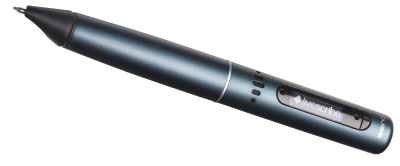
I bring a Livescribe Pulse smartpen (https://www.livescribe.com) to classes. The Livescribe Pulse allows me to record both what I say and what I draw/write on special paper. This recording can then be shared as an embedded Flash video, exported as a PDF, or exported as an audio file. The term that Livescribe has coined for this process is “pencasting.”

The Livescribe Pulse comes in two versions: 1GB or 2GB capacity. The 2GB version has the capacity to store up to 200 hours of audio. The pen requires special dot paper to record and digitize what is written. The dot paper can be purchased in a variety of formats (notebooks, journals, notepads), or printed via certain color laser printers. Livescribe provides free hosting services to share pencast recordings.

The advantage of using the Livescribe Pulse is that all I need to carry with me is the pen and paper. If a classroom has an overhead projector, I can provide an ad-hoc presentation or lesson and then share this as a video after the class.

The three-stage process is as follows:

  1. Recording
    As soon as I start speaking or writing, I start recording. The pen has a built-in microphone that picks up my voice. The Livescribe Pulse synchronizes the recording of my voice with whatever I draw or write. I can pause audio recording if required.

  2. Importing and Editing
    After class I dock the Livescribe Pulse with my computer. The recording is copied over to a desktop application, which enables me to make changes to the metadata and title the session.

  3. Distribution
    The desktop software allows me to export the session as an audio file with accompanying PDF. My preferred format is an Adobe Flash video, which can be embedded in any web page or shared via Facebook. The limitation to this approach is that Livescribe only provides 250MB of shared storage. My hope is to find an alternative way to export video files directly from the desktop


Labels: , ,

Monday, July 27, 2009

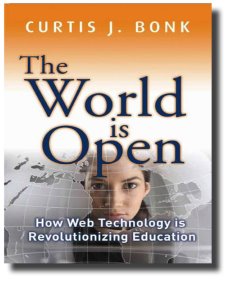
The World is Open


Last year I attended the CAP (Commission for Accelerated Programs) Accelerated Online and Blended Learning Workshop in Denver, and was lucky enough to see Curt Bonk’s presentations and then share these with my Livescribe Pulse Pen (the complete details and links are on my blog). Little did I know that the experience would turn up in Curt’s next book…


Curt kindly sent me a copy this past week. I appear on page 302. You can read the excerpt whilst listening to the recording.

The book ("The World Is Open: How Web Technology Is Revolutionizing Education") operates as a response to Thomas Friedman’s “The World Is Flat” - demonstrating how learning has been flattened in such a way that "anyone can now learn anything from anyone at anytime." This is both revolutionary and evolutionary. The concepts of traditional education are challenged, as is the role of the university.

Curt positions his argument with ten openers (WE-ALL-LEARN):

  1. Web Searching in the World of e-Books
  2. E-Learning and Blended Learning


  3. Availability of Open Source and Free Software
  4. Leveraged Resources and OpenCourseWare
  5. Learning Object Repositories and Portals


  6. Learner Participation in Open Information Communities
  7. Electronic Collaboration
  8. Alternate Reality Learning
  9. Real-Time Mobility and Portability
  10. Networks of Personalized Learning

There are two versions of the book: currently available is a dead tree version, available soon will be the ebook. The ebook will have same chapter sequence and same size, but different content (including a prequel and postscript). The ebook will be available from https://worldisopen.com in two months (or less).


Here is what Curt has to say on the ebook: “With the firm belief of open education and open access, there will actually be a 2nd free e-book extension (same chapters, same size, different content) since I wrote too much as well as a prequel and postscript. https://worldisopen.com/. This will be out in 1-2 months.”


I highly suggest you take a look at the book, ebook and blog.

Labels: , , , , ,