 |
||
 |
        |
|
      |
|
 |
|
 |
|
 |
|
 |
|
|
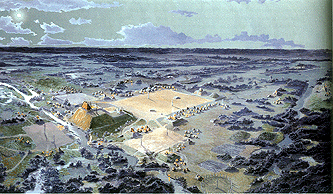
"At the turn of the last millennium, a powerful Native American civilization emerged and flourished in the American Midwest. By C.E.. 1050 the population of its capital city, Cahokia, was larger than that of London. Without the use of the wheel, beasts of burden, or metallurgy, its technology was of the Stone Age, yet its culture fostered widespread commerce, refined artistic expression, and monumental architecture.
"The model for this urbane world was nothing less than the cosmos itself. The climax of its ritual center was a four-tiered pyramid covering fourteen acres, rising a hundred feet into the sky — the tallest structure in the United States until 1867." "When the Native Americans left, the land was without human stewardship, becoming a desolate overrun ruin, but three hundred years later, French priests and monks gave the place Christian value, imprinted with a log chapel topped by a wooden cross. When the settlers of the early nineteenth century arrived, their agricultural values turned the land into plowed fields and fruit tree orchards on the top of Monks Mound. Later railroad tycoons and real estate developers, coveting the land for its economic value, leveled many mounds and turned parts of the old Native American grounds into embankments, levees, and drainage ditches. In the twentieth century new economic motives brought housing subdivisions, a drive-in movie, and even an airport to the site. Finally, a small piece of the original site was declared an Illinois state park. On the old ceremonial plaza, local inhabitants picnicked in the shady groves in summer, children played on seesaws and swings in the fall and sledded on Monks Mound in winter. A piece of Cahokia had been preserved by giving it recreational value. With the arrival of professionals on the staff, the site finally gained recognition of its historical value — it was declared a UNESCO World Heritage Site, with cultural resources that belonged to the "common inheritance of all mankind". When contemporary Native Americans revisit Cahokia, the land regains some of the spiritual value it had long ago. Today visitors from all over the world have endowed Cahokia with a continuing humanistic value." Epilogue: As if a cosmic denoument were in order, when the star-studded sky darkened it gave greater brilliance to a sight seen once in six thousand years — the streaming tail of the Hale — Bopp Comet. I knew that in 1066 the Cahokians had seen Halley's Comet crossing the sky. As I stood gazing at the stars above me and the mound city below, a Native American poem I had memorized came to my mind: "There is purity and strengthFor a more detailed excerpt of Cahokia: Mirror of the Cosmos, click here. |