 |
||
 |
        |
|
      |
|
 |
|
 |
|
 |
|
 |
|
|
"Outstanding book in Architecture and Urban Planning Award, Seventeenth Annual Professional and Scholarly Book Division"
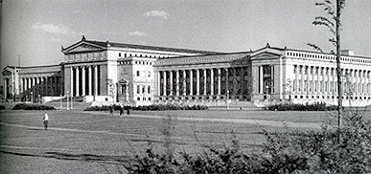
--- the Association of American Publishers in 1992. To focus on a pervasive change that took place in the mainstream of American architecture in the first third of the twentieth century, Sally A. Kitt Chappell traces the work of one of the leading firms. This change involved transforming traditional canons and making creative adaptations of standard forms to solve some of the largest architectural problems of the times — railroad stations, civic monuments, banks, offices, and department stores. Chappell's study shows how the firm exemplified the changing urban hierarchy of the American city. Their work emerges as both an index and a reflection of the changing urban values of the twentieth century. Interpreting buildings as cultural artifacts as well as architectural monuments, Chappell illuminates broader aspects of American history, such as the role of public-private collaboration in city making, the image of women reflected in the specially created feminine world of the department store, the emergence of the idea of an urban group in the heyday of soaring individual skyscrapers, and the new importance of electricity in their social order. It is Chappell's contention that what people cherish and preserve says more about them than what they tear down and discard in favor of the new. Working from this premise, she considers the values conserved by architects under the pressure of ever changing demands. Her work enlarges the scope of inquiry to include ordinary buildings as well as major monuments, the timeless as well as the timely, thus offering a view of American architecture of the period at once more intimate and substantial than any seen until now. Richly illustrated with photographs and plans, this volume also includes handsome details of such first-rate works as the Thirtieth Street Station in Philadelphia, the Cleveland Terminal Group, and the Wrigley Building in Chicago. |