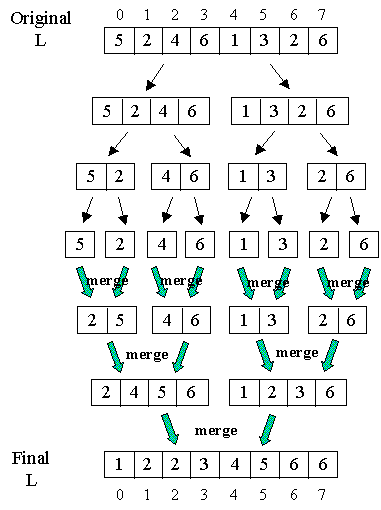
| Problem: Sort elements in a list L of length n (whose index
is 0 through n-1) in an ascending order. Input: L (a list), and i, j (indices) Output: nothing. Elements in L will be sorted in place. procedure MergeSort(L, i, j) 1. if i = j then // base case; 1-element sequence 2. return 3. m := floor((i+j)/2) 4. MergeSort(L, i, m) // recursive call to left half 5. MergeSort(L, m+1, j) // recursive call to right half 6. Merge(L, i, m, j) // merge 2 sequences L[i thru m] & L[m+1 thru j] end MergeSort |
-------------------------------------------------------------------
The Merge Procedure
Problem: Combine two lists into one list so that elements in the
resulting list are sorted in ascending order.
Input: L (a list), and i, m, j (indices) where i <= m <=
j. There are n elements between L[i] and L[j] (inclusive).
Output: nothing. Elements in a sublist in L will be sorted in
place.
Example: Merge two lists [1, 3] and [2, 6] in L = [5, 2, 4, 6, 1, 3, 2, 6] and i = 4, m = 5, j = 7
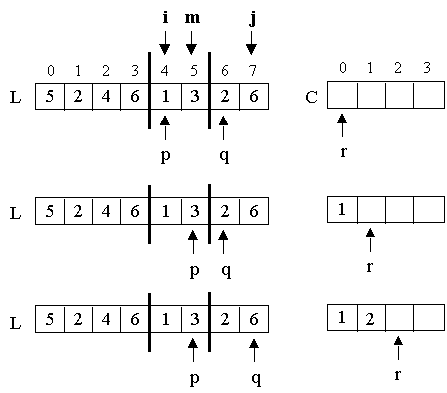
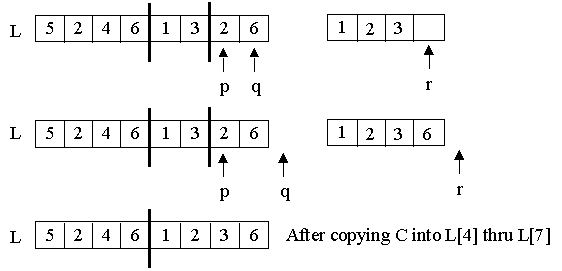
- The algorithm for Merge:
procedure Merge(L, i, m, j)
1.  p := i           // index for the first list
2.  q := m + 1       // index for the second list
3.  C := array of size (j - i + 1)  // temporary list
4.  r := 0           // index for C
5.  while (p <= m) and (q <= j) do
6.    begin
7.    if (L[p] < L[q]) then  // L[p] is smaller
8.      begin
9.      C[r] := L[p]     // put it in C
10.     p := p + 1
11.     end
12.   else                   // or L[q] is smaller
13.     begin
14.     C[r] := L[q]     // put it in C
15.     q := q + 1
16.     end
17.   r := r + 1         // either case, increment r
18.   end
19. while (p <= m) do  // copy items left in the first half into C
20.   begin
21.   C[r] := L[p]
22.   p := p + 1
23.   r := r + 1
24.   end
25. while (q <= j) do  // copy items left in the second half into C
26.   begin
27.   C[r] := L[q]
28.   q := q + 1
29.   r := r + 1
30.   end
31. p := i             // reset p
32. r := 0             // reset r
33. while (p <= j) do  // copy items in C back into L
34.   begin
35.   L[p] := C[r]
36.   p := p + 1
37.   r := r + 1
38.   end
end Merge
- Complexity of Merge procedure
Count the total number of times elements in L are copied into C (and ignore the times needed to copy elements in C back into L in the last while-loop. It is (j - i + 1 ) = n times.
-------------------------------------------------------------------
back to MergeSort
Notation: A(n) denotes the number of times elements are
moved/copied in Merge, when there are n elements between i and
j (i.e., n = i - j + 1).
Note the analysis here is slightly different from the textbook.
Recurrence relation:
|
We know how to solve this recurrence and derive complexity.
(will do in the class)
Closed form:
Theta complexity:
|
Case analysis:
- Worst case -- Q(_______).
- Best case -- Q(_______).
- Average case -- Q(_______).