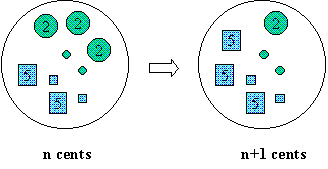
The problem is to show that, for all integers n >= 4, n cents can be obtained using 2-cent and 5-cent coins. To prove this by mathematical induction, the idea is to come up with scheme(s) from n cents to n+1 cents. Suppose we have a bag which contains some 2-cent and 5-cent coins mixed in, and whose total amount is n cents. We want to add/remove some coins to make the bag containing n+1 cents.
There are (at least) two schemes to go from n cents to n+1 cents:
The proof also must show that no matter what the current configuration of n cents is, either one (or at least one) of the schemes above will ALWAYS apply.
Proposition: For all integers n >= 4, n cents can be obtained using 2-cent and 5-cent coins only.
Proof: by induction.
Basic Step (n = 4):
4 cents can be made by two 2-cent coins. ... (A)
Inductive Step:
[Inductive Hypothesis] Assume n cents (where n >= 4) can be made by using 2-cent and 5-cent coins only.
[Inductive Case] Show n+1 cents can be made by using 2-cent and 5-cent coins only as well.
- Case 1: If n cents includes (at least) two 2-cent coins, we can take out two 2-cent coins, and add one 5-cent coin to make n+1 cents.
- Case 2: If n cents includes (at least) one 5-cent coins, we can take out one 5-cent coin, and add three 2-cent coins to make n+1 cents.
The configuration of n cents is always Case 1 or 2 (or both; and no other case), since n >= 4. More specifically, having 4 or more cents implies
- there are at least two 2-cents coins; or
- there is at least one 5-cent coin.
in the bag. Note the second situation only holds when n >= 5. But when n = 4, the first situation holds. So, there is no n value missed by the two situations above. ... (B)
Therefore, from (A) and (B), the proposition is true. QED.