 |
||
 |
        |
|
      |
|
 |
|
 |
|
 |
|
|
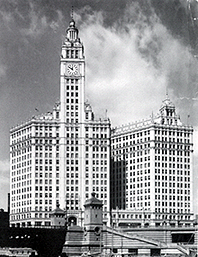 "Some aspects of a city seem immutable, others change slowly and only under special circumstances. There are some moments when the whole urban fabric rapidly takes on a new form. These shifts in the material world can only occur when there are concomitant changes in the political, social, and economic life of the community. In the period 1912 to 1929, ideas about civic order changed radically.
The commercial world impinged on the cultural world as it never had before. Graham, Anderson, Probst and White, one of the most prolific architectural firms of this period, erected hundreds of buildings in cities from New York to Pasadena, providing a microcosm of a larger metamorphosis in American history." "Privileged to work in one of the great building periods in American history, they in turn modified and created new elements within the larger civilization of which they were a part: public buildings, cultural institutions, railroad stations, office buildings, industrial lofts, manufactories, laboratories, warehouses and garages." The process of change accelerated. Cultural and civic institutions were subsumed in whole or in part into office buildings. Office buildings had climbed from the lowest levels of the urban hierarchy to the middle. Some structures at the bottom of the hierarchy — such as electrical power plants and warehouses — began to move upward. In this way, the architectural world reflected changes in society at large. Some of their works were beautiful; a few were masterpieces. |