Introduction:
"Chicago is at the forefront of an international effort to expand and nurture civic life through a merger of public open spaces and civic institutions. In this new era, the green world becomes a vital part of the cultural meaning of the whole build environment. Parks and other open spaces are no longer an adjunct to city life, passive areas of retreat; rather, they are dynamic, culture-creating forces with documented health and social benefits. Integrating green spaces into the city creates a more interactive and humane environment.
The great cities of the world— Rome, Paris, Istanbul, Petersburg, Beijing, and Kyoto to name a few—have been doing this, each in its own way, for centuries. Chicago has now entered their ranks."
Millennium Park:
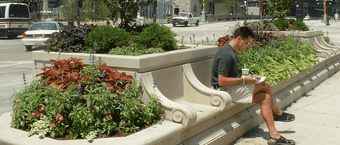
“The pleasures of being out of doors are abundant in Millennium Park. You can wade in water, watch a changing cloudscape, and smell roses. You can feel the earth beneath your feet, a fresh lake breeze on your cheek, and see fish dart in and out of reeds. You can escape to a bench in a quiet corner or along a promenade and read a favorite book during your lunch hour. These are all time-honored reasons that people go to parks.
But Millennium Park also offers new experiences, meeting the new needs of the twenty-first century. The list of new combinations is long: the synthesis of nature and culture, architecture and sculpture, landscape architecture and urban planning, contemplative spaces and facilities for large-scale events—all accomplished through exemplary public-private cooperation. But the combination is more than the sum of these parts. The end result is a paradigm shift in urban design: multiethnic, interactive land use in which a park is transformed from a merely passive, or recreational space, to a culture-producing civic institution."
Ping Tom Park:
“When the flashing silver streaks of Metra or Amtrak trains pass through the lift bridge downstream, or pleasure boats ripple the reflections of a nearby industrial warehouse before docking at the park, it all seems part of some yin-yang fusion of nature and culture. To think that watching a vertical lift bridge raise its enormous span to let a flotilla of barges, sailboats, yachts, and canoes pass underneath would be the spectacle served up to an audience in a Chinese garden in Chicago!"
University of Chicago:
"Today the University of Chicago has the overall air of a distinguished institution in an atmosphere of rigorous clarity and gentle humanism. This impression comes from the buildings and grounds together, the physical form of an institution that has produced seventy-three Nobel Prize winners in the world of ideas.
The historic center of the campus is a complex of some thirty vine-covered neo-Gothic buildings that define six spacious courtyards, or quadrangles. Built in the 1890s, they enclose this four-block area without walling it off. Broad gateways open out on all sides, while within the atmosphere is that of a scholarly retreat."
Conclusion:
"One reason for Chicago’s success is the political climate. In other cities local governments have relinquished their watchdog role in protecting the public realm…Architecture is not only an aesthetic art or a utilitarian art at the service of builders and property owners. It is also a civic art. At this time in our history, architects and the landscape professionals on their design teams must reassert their role as protectors of the public realm. With the support of lawmakers and other officials they can do their job. Without it, city life will be impoverished.
Although the ideal city will always be elusive—changing times will always give rise to new needs—aiming for a city where people have both nature and culture close at hand is a useful humanistic goal, worthy of the best efforts its citizens can muster. Shooing for that star brings us closer to it.”
|