 |
||
 |
        |
|
      |
|
 |
|
 |
|
 |
|
 |
|
|
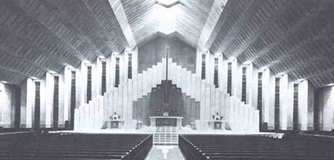
Barry Byrne's most original contributions to history came in the field of church architecture. His work was without precedent: it was by necessity, as well as by design, strikingly original.
Byrne had assimilated the teachings of Frank Lloyd Wright during his seven years as an apprentice in the Oak Park Studio. Secular work: Hugh Gilmore house, Mason City, Iowa; J.B. Franke house, Fort Wayne, Indiana; Immaculata High School, Chicago; Michael Williams house, Westport, Connecticut. Ecclesiastical Work: St. Thomas Apostle, Chicago; St. Patrick, Racine, Wisconsin; Church of Christ the King, Tulsa, Oklahoma; Church of Christ the King, Cork, Ireland; Church of Saints Peter and Paul, Pierre, South Dakota; St. Francis Xavier Church, Kansas City, Missouri; Church of St. Columba, St. Paul, Minnesota; St. Benedict's Abbey, Atchison, Kansas. In the end, out of his desire to embody both the meditative and the communal, both the withdrawal from the material world and the affirmation that all of life is one great fabric, Byrne created spaces which expressed his idea that a church should bring into play "all of man's faculties so that he will not only know, he will also see; he will not only apprehend, he will also feel. The entire being will be in accord." The University Microfilms dissertation version is available from University Micrfilms, Ann Arbor, Michigan. The Chicago Historical Society catalog is out of print and available only in libraries. |