|
|
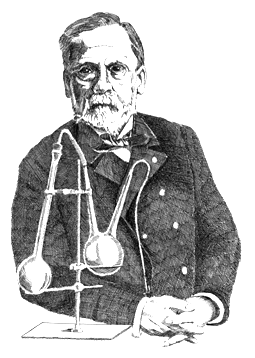
Louis Pasteur |
|
|
Louis Pasteur |
Biology
210: Microbiology
Lifestyles
of the itty-bitty
Phillip
E. Funk, Ph.D., Assistant Professor of Biology
Lecture:
M,W,F 9:40-10:40
Laboratory:
T 8:30-11:30, 2:30-5:30
Teaching
Assistants: Christopher Becker and Jessica Palmer
SPRING
2002

COURSE SUMMARY
Course Objectives:
Course format:
Lecture/discussion/laboratory
| PRINCIPLE
TOPICS COVERED Topic |
Approximate % |
| Introduction to Microbiology | 10 |
| Classification of Microorganisms | 20 |
| Microbial Metabolism | 20 |
| Microbial Genetics | 20 |
| Immunology | 10 |
| Microorganisms in Medicine and Industry | 20 |
Required Textbook: Microbiology:
Principles and Explorations, 4th edition,
by Jacquelyn Black. This is an excellent introductory text to the
broad field of microbiology. This book also includes a companion
web site with supplementary materials and quizzes so that you can
test yourself. A link is available on the course website. (http://condor.depaul.edu/~pfunk/210index.html
The laboratory manual is Microbiology
Laboratory: Fundamentals and Applications by George A.
Wistreich. In addition you must buy a disposable laboratory coat.
These coats are for your protection! We will be working with
stains that could ruin your clothing and some potentially
infectious organisms. This coat will be kept in the laboratory
for you to use. At the end of the quarter the teaching assistants
will autoclave the coats and dispose of them. You must have this
lab coat for the first day of laboratory.
All required supplies are available in the
campus bookstore.
Additional materials may be handed out in
class or placed on reserve in the library. The class website will
also have links to material on the World Wide Web that will be
helpful in your studies.
| COURSE EVALUATION | Weight (%) |
| Exam I | 20 |
| Exam II | 20 |
| Exam III | 30 |
| Laboratory: | |
| Laboratory Reports | 15 |
| Laboratory Exam | 15 |
Grading: Exams will be a combination
of multiple choice, short answer, matching, and fill in the blank
type questions. Exams will be held at the times indicated, any
exceptions to this must be arranged with me well ahead of time.
There will be no make up examinations without adequate reason for
why the exam was missed in the first place. Make up exams must be
arranged by the college of Liberal Arts and Sciences, there is a
fee for this.
Since I post my lecture notes to the web I
feel free to require a good deal of specificity in the answers I
expect on the exams. You will be tested on your ability to unite
concepts presented in different lectures and to think
analytically about the information presented in class. The
essential ability you should acquire as a young scientist is to
reason logically from what you know.
Laboratory reports are due to the teaching
assistants by the next laboratory period after the exercise is
completed. Late reports will receive an unsatisfactory grade.
Attendance at the laboratory is absolutely required and you must
attend your assigned section in the laboratory. There will be no
make up labs. I may excuse you from a lab if given a valid,
verifiable reason for the absence.
Statement of Academic Honesty: It is expected that your work in this course will be original, not copies of another student's work. The university dictates strong sanctions against those who copy another's work without citing the original source. This may also apply to students who allow others to copy their work. This sanction may be as severe as an F in the course. Please refer to the student handbook for a more detailed discussion of the university's rules on this matter. In the laboratory portion of this course you will be required to share your data with other students in order to gain a more complete understanding of the experiment. In writing the laboratory report I expect a clear distinction between YOUR results and those obtained by sharing results with others. Science is a collaborative endeavor but it requires acknowledgement of one's collaborators.
Behavior: You should be on time for both lecture and lab. You should behave as you would like an audience to behave if you were speaking. TURN OFF ALL CELL PHONES AND BEEPERS. No talking, note passing, horseplay, etc. Your success in this course depends primarily on you! In the laboratory it will be necessary to share reagents, equipment, and results with others. You should be courteous and respectful of your fellow students. Inappropriate and rude conduct in the lab will not be tolerated. Smoking, eating, drinking, and applying make-up are absolutely forbidden in the lab. Extraneous conversation should be kept to a minimum.
Tips for success in this course:
CONTACTING YOUR INSTUCTOR:
You may contact me by email at pfunk@depaul.edu
My office is 243 McGowan Hall on the Lincoln Park Campus.
I will also be available before and after lecture to answer specific questions. If necessary I will establish office hours. I will do my utmost to answer questions in a timely fashion. I sincerely want this course to be a rewarding educational experience for you.
You may contact your teaching assistants in
245 McGowan or by email at:
Chris:
christopherbecker@hotmail.com
Jessica:
jesspalmer@earthlink.net
Office hours for the teaching assistants will be posted.
Date |
Topic |
Reading
Assignment |
April
1 |
Introduction:
Course Overview and History |
Black,
Chapter 1 |
2 |
Laboratory:
NO Laboratory This Week |
|
3 |
Chemistry
Fundamentals |
Black,
Ch. 2 |
5 |
Microscopy
and Staining |
Black,
Ch. 3 |
8 |
The
Prokaryotic Cell |
Black,
Ch. 4 |
9 |
Laboratory:
Laboratory Introduction, Microscopy Bacterial Morphology
and Staining Characteristics |
Wistreich,
Exercises 1,2,14 &16 |
10 |
Metabolism
I |
Black,
Ch. 5 |
12 |
Metabolism
II |
Black,
Ch. 5 |
15 |
Metabolism
III, Fermentation |
Black,
Ch. 5 |
16 |
Laboratory:
Bacterial Culture Techniques |
Wistreich,
Exercises 4, 5, & 6 |
17 |
Bacterial
Growth |
Black,
Ch. 6 |
19 |
Microbial
Genetics I |
Black,
Ch. 7 |
22 |
Microbial
Genetics II |
Black,
Ch. 7 |
23 |
Laboratory:
Enterobacteria Identification, Differential Media |
Wistreich,
Exercises 20 & 27 |
24 |
Recombinant
DNA Technology |
Black,
Ch. 8 |
26 |
Exam
I |
|
29 |
Taxonomy
I |
Black,
Ch. 9 |
30 |
Laboratory:
Transformation |
Wistreich,
Exercise 41 |
May
1 |
Taxonomy
II, The Archaea |
|
3 |
Viruses
I |
Black,
Ch. 10 |
6 |
Viruses
II |
Black,
Ch. 10 |
7 |
Laboratory:
Microorganisms in the Environment, Effects of UV Light |
Wistreich,
Exercise 12, 30 |
8 |
Fungi |
Black,
Ch. 11 |
10 |
Eukaryotic
Microbes and Parasites |
Black,
Ch. 11 |
13 |
Sterilization
and Disinfection |
Black,
Ch. 12 |
14 |
Laboratory:
Bacteriophage |
Wistreich,
Exercise 38 |
15 |
Antibiotics |
Black,
Ch. 13 |
17 |
Exam
II |
|
20 |
Medical
Microbiology I |
Black,
Ch. 14 |
21 |
Laboratory:
Antibiotic Resistance, Indigenous Flora |
Wistreich,
Exercise 37, 58 |
22 |
Medical
Microbiology II |
Black,
Ch. 15 |
24 |
Immunology
I |
Black,
Ch. 16 |
27 |
Memorial
Day, No Class |
|
28 |
Laboratory:
Agglutination Reactions, Review Session |
Wistreich,
Exercise 50 |
29 |
Immunology
II |
Black,
Ch. 17 |
31 |
Immunology
III |
Black,
Ch.18 |
June
3 |
Food
Microbiology I, Industrial Microbiology |
Black,
Ch. 26 |
4 |
Laboratory:
Laboratory Exam |
|
5 |
Environmental
Microbiology |
Black,
Ch. 25 |
7 |
Review
Session |
|
Final Exam Thursday, June 13, 2002, 8:45-11:00
am
Microbiology: Principles and Explorations- Companion Website for your textbook. This is an excellent resource with links to supplementary material and very helpful review questions. A lazy professor might consider using some of the questions on this site for exams.
Microbiology Courses at Other Universities:
University of Wisconsin
The Bad Bug Page - From the Food and Drug Administration
The American Society for Microbiology
Internet Resources for Biology
MicrobeWorld - information on our microbial friends and enemies from the American Society for Microbiology
Virtual Library of Biosciences
DIVERSIONS: