
Volume 5, Article 1
January 2001
|
|
|
|
Carol V. Brown
Iris
Vessey
Kelley School of Business
Indiana University
ABSTRACT
NIBCO, Inc., a mid-sized manufacturer of valves and pipe fittings headquartered in the U.S. with $460 million annual revenues, implemented SAP R/3 across its 10 plants and 4 new distribution centers with a Big Bang approach in December 1997. NIBCO management agreed with the Boston Consulting Group recommendation to "cut loose" from its existing legacy systems and replace them with common, integrated systems for finance, materials management, production, and sales/distribution, such as offered in the ERP packages of major vendors by the second half of the 1990s. However, the company leaders chose not to heed the advice of their consultants, or the current trade press, about taking a slower, phased-in approach. Instead, they developed plans for a Big Bang implementation of all modules (except HR) with a $17 million budget and a project completion date 15 months later that allowed for only a 30-day grace period.The project is led by a triad of NIBCO managers with primary accountabilities for business process, IT, and change management. The case describes the legacy IT environment, the ERP purchase and implementation partner choices, the selection and composition of what came to be called the TIGER team, the workspace design for the project team (TIGER den), the key issues addressed by each project sub-team, the incentive scheme, and the complexity added by a distribution center consolidation initiative that runs behind schedule. The case story ends shortly after the Go Live date, with the project leaders replaying their warnings to the executive team about initial dips in productivity and profits.
Editor’s Note: This case was the winner of Best Teaching Case award at the International Conference on Information Systems, 2000 that was held December 11-13 in Brisbane Australia. This article will also be published in: Martin, E.W., C.V. Brown, D.W. DeHayes, J.A. Hoffer, and W.C. Perkins. Managing Information Technology, 4th edition, Prentice Hall, 2001.
December 30, 1997 was the Go Live date at NIBCO INC., a privately held mid-sized manufacturer of valves and pipe fittings headquartered in Elkhart, Indiana. In 1996 NIBCO had more than 3,000 employees (called "associates") and annual revenues of $461million. Although many of the consultants they had interviewed would not endorse a Big Bang approach, the plan was to convert to SAP R/3 at all ten plants and the four new North American distribution centers at the same time. The price tag for the 15-month project was estimated to be $17 million. One-quarter of the company's senior managers were dedicated to the project, including a leadership triad that included a former VP of Operations (Beutler), the Information Services director (Wilson), and a former quality management director (Davis).
We took ownership: it was our project, not theirs. We
used the consultants for what we needed them for and that was technology skills,
knowledge transfer, and extra hands.
It was brutal. It was hard on families, but nobody
quit, nobody left…. Professionally I would say it was unequivocally the
highlight of my career.
NIBCO’s journey to the Go Live date began about three years earlier, when a significant strategic planning effort took place. At the same time a cross-functional team was charged with reengineering the company’s supply chain processes to better meet its customers' needs (see Timeline in table 1). One of the key conclusions from these endeavors was that the organization could not prosper with its current information systems. The firm’s most recent major investments in information technology had been made over five years earlier. Those systems had evolved into a patchwork of legacy systems and reporting tools that could not talk to each other.
|
|
|
| Early 1995 | Cross-functional teams charged with developing NIBCO’s strategic plan and reengineering supply chain processes determined that company could not prosper with its current information systems. |
| May, 1995 | Gary Wilson hired as new head of IS department. |
| August – December, 1995 | Boston Consulting Group conducted strategic IT planning study. Recommended that NIBCO replace its legacy systems with integrated enterprise system on client-server platform over a 3- to 5-year timeframe |
| January 1, 1996 | Restructured corporation into cross-functional matrix organization. Scott Beutler, former VP of Operations–Residential Division, given responsibility for business system strategic planning, including selection of an ERP package. |
| July, 1996 | Committee recommended purchase of SAP R/3 and "Big Bang" implementation. Approved by Executive Leadership Team (ELT) and Board of Directors. |
| August, 1996 | Contracts signed
with SAP for R/3 modules and IBM as implementation partner.
Wilson, Beutler, and Davis form triad leadership team. |
| September, 1996 | Completion of
project team selection and September 30th project
kickoff. Begin Preparation phase. |
| December, 1996 | Final project scope and resource estimates presented to ELT and Board with Go Live date of Monday, November 29, 1997 (30-day grace period allowed). Final scope included North America only and consolidation of warehouses to a number yet to be determined. Final project budget was $17 million. |
| March, 1997 | Decision to
consolidate warehouses from 17 to 4 by September, 1997.
Incentive pay bonus in place a few months after project initiated. |
| April, 1997 | Installation of
PCs for customer service associates completed. Weekly newsletter via e-mail initiated. |
| May, 1997 | Business Review lead for materials management leaves company; role filled by Business Review lead for production planning. |
| Summer, 1997 | Maintenance of legacy systems discontinued except for emergency repairs. |
| September, 1997 | User training begins at NIBCO World Headquarters and at remote sites. Sandbox practice system becomes available. |
| November, 1997 | Go Live date moved from Monday following Thanksgiving to December 30 due to delays in completion of warehouse consolidation and master data load testing. |
| December 30, 1997 | Go Live without consultants |
After initial talks with several consulting firms, top management brought in the Boston Consulting Group (BCG) in August 1995 to help the company develop a strategic information systems plan to meet its new business objectives.BCG brought in a team and what they instantly did was to start going through each of the functional areas of the company to determine the need for changes….And so they went into each little nook and cranny of the company and sorted out whether we really needed to change every system we had. Jim Davis, Project Co-Lead, Change Management
The consensus among NIBCO's management team was that the company was "information poor" and needed to be "cut loose" from its existing systems. There were also major concerns about being able to grow the company and become more global without an integrated information capability. The December 1st BCG recommendation was that NIBCO replace its legacy systems with common, integrated systems that could be implemented in small chunks over a 3- to 5-year timeframe.They told us ‘you really need to look at integration as a major factor in your thought processes—the ability to have common systems with common communication for the manufacturing area, the distribution area, across the enterprise.' The company began to reorganize into a cross-functional, matrix structure in January 1996. It also initiated a new cross-functional strategic planning process. Scott Beutler was relieved of his line management responsibilities to focus on the development of a new IT strategy. Beutler had joined NIBCO in early 1990 as general manager of the retail business unit. When this business unit was restructured, he became the VP of Operations—Residential Division. Beutler was charged with learning whether a new type of integrated systems package called enterprise resource planning systems (ERP) would be the best IT investment to move the company forward.Scott Beutler, Project Co-Lead, Business Process
III. INFORMATION SYSTEMS AT
NIBCO
Gary Wilson was hired as the new head of the IS department in May 1995 and became a member of the BCG study team soon after. Wilson had more than 20 years of IS experience, including managing an IS group in a multi-divisional company and leading four major project implementations. He reported to Dennis Parker, the Chief Financial Officer.Wilson inherited an IS department of about 30 NIBCO IS specialists, including those who ran mainframe applications on HP3000 and IBM/MVS platforms. About one-half were COBOL programmers. The IS payroll also included a number of contractors who had been at NIBCO for up to five years.
Four major legacy systems supported the order entry, manufacturing, distribution, and accounting functions (Figure 1). The business units had purchased their own packages for some applications and plants were running their own versions of the same manufacturing software package with separate databases.
We had a neat manufacturing package that ran on a Hewlett Packard, an accounting system that ran on an IBM, and a distribution package that was repackaged to run on the IBM. Nothing talked to each other. Distribution couldn’t see what manufacturing was doing and manufacturing couldn’t see what distribution and sales were doing. Jan Bleile, Power User
At the time of the BCG study, there was widespread dissatisfaction with the functionality of the legacy environment and data was suspect, at best, because of multiple points of access and multiple databases. The systems development staff spent most of their time building custom interfaces between the systems and trying to resolve the "disconnects."

Figure 1. Legacy Systems at NIBCO
IV. THE ERP SELECTION TEAM
Beutler set up a cross-functional team to select an ERP package early in 1996. CFO Parker was the executive sponsor and it included eight other, primarily director-level, managers. Wilson played an internal technology consultant role for Beutler while still managing the IS group, which was heavily immersed in a new data warehousing project.Seven ERP packages were evaluated in depth. Representatives from the various functional areas participated in walkthroughs of specific modules, and the selection team also visited several different vendors’ customers. The strengths and weaknesses of each package were mapped into an evaluation matrix. One of the key decisions was whether to wrap a series of best-in-class finance and supply chain solutions around a common database, or whether to select a single ERP system that integrated all the modules.
The selection team also did some benchmarking on implementation approaches and success rates. Some of the team members sensed that the BCG recommendation for a 3- to 5-year phased ERP implementation was not the best approach for NIBCO. The fear was that the company would just get to the point where it would say "enough is enough" without executing the whole plan. Team members had also observed that some of the companies that had used a phased, "go-slow" approach were not among the most successful. At the same time business initiatives were demanding a quicker implementation.Jim Davis, who had led a reengineering team for the strategic planning process, was asked to facilitate the selection team’s formulation of a recommendation to the Executive Leadership Team (ELT).
Because of my facilitation experience, I was asked to facilitate that meeting so that there would be an objective person who had no particular interest or bias to help lead the discussion…. It actually was a bit of a breakthrough because in the context of that meeting we changed our approach from the point solution over three to five years to an ERP Big Bang. In July 1996, the ERP selection team recommended to the ELT that NIBCO purchase a single ERP system: SAP R/3. Among the benefits would be multi-million dollar operational improvements and reductions in inventory costs; the ROI was based on a 6% forecast growth rate in NIBCO’s revenues. The cost estimates included the move from a mainframe to a client/server platform and an estimated number of R/3 licenses. Although consulting costs under the Big Bang approach were still expected to be high—about one-third of the project budget—they would be lower than the 1000 days estimated for the 3- to 5-year phased approach. Either approach would involve a big increase in IS spending. The ELT supported the recommendation to implement R/3 as quickly as possible—pull the people out of the business to work on it, focus, and get it done.Jim Davis, Project Co-Lead, Change Management
The R/3 purchase and Big Bang implementation plan were then presented to NIBCO’s Board of Directors. The Board viewed the Big Bang approach as a high-risk, high-reward scenario. In order to quickly put in place the systems to execute the new supply chain and customer-facing strategies, which had come out of the strategic planning process, the company would have to commit a significant portion of its resources. This meant dedicating its best people to the project to ensure that the implementation risks were well managed.
A contract was signed with SAP for the FI/CO, MM, PP, SD, and HR modules and about 620 user licenses soon afterward. The HR (Human Resources) module would be implemented later. Rex Martin, chairman, president and CEO of NIBCO, assumed the senior oversight role.
Once the team's Big Bang recommendation was endorsed, Beutler began to focus on the R/3 implementation project. The initial idea was to have Wilson co-lead the R/3 project with Beutler. In an earlier position, Wilson had worked on "equal footing" with a business manager as co-leads of a project involving a major platform change, and it had been a huge success. He therefore quickly endorsed the idea of co-leading the project with Beutler. Between the two of them there was both deep NIBCO business knowledge and large-scale IT project management knowledge. Although Beutler was already dedicated full-time to the ERP project, Wilson would continue to manage the IS department as well as co-lead the project for the next 18 months.Shortly after the Board decision in late July, Rex Martin asked Jim Davis to join Beutler and Wilson as a third co-lead out of concern for the high strategic risk of the project. Martin had been the executive sponsor of a team led by Davis that reengineered strategic planning at NIBCO. The morning after Davis agreed, Martin introduced Davis as the third co-leader of the project, and then let the three directors work out what roles they were going to play.
As the three co-leads looked at what needed to be accomplished, it became clear that Davis’ experience with total quality management initiatives could bring focus to the change management aspects of the project. Davis split his time between his quality management job and the R/3 project for about a month, and then began to work full-time on the ERP implementation.
One of the things we did was a lot of benchmarking…and one of the things we kept hearing over and over was that the change management was a killer. Having been in the IT business for a long time, I realized it was a very, very key element. With the opportunity to give it equal footing, it sounded like we could really focus on the change management piece. Gary Wilson, Project Co-Lead, Technology
The R/3 project team came to be called the TIGER Team: Total Information Generating Exceptional Results. The project was depicted as a growling tiger with a "break away" motto, symbolizing the need to dramatically break away from the old processes and infrastructure (Figure 2). In the figure, a triangle symbolized the triad leadership with responsibilities for Technology (Wilson), Business Coordination (Beutler), and Change Management (Davis).
I was pretty sensitive to change management because of my TQM role and so in the conversation I could say ‘look guys, if we don’t get people to play the new instrument here, it could be a great coronet—but it’s never gonna blow a note.’Jim Davis, Project Co-Lead, Change Management
-
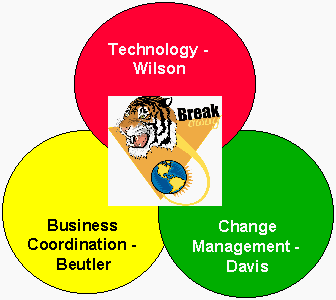
Figure 2. Tiger Leadership
The three co-leads spent significant amounts of time together on a daily basis, including Saturday mornings. Each brought completely different perspectives to the project. They talked through all the issues together and most major decisions, even more technical decisions, were made as a triad.Rex Martin was the executive sponsor for the team, and also came to be viewed as the project champion. It was Martin’s responsibility to ensure that the VPs supported the project and were willing to empower the project leaders to make decisions. The project co-leads informed him of the key issues and Martin eliminated any roadblocks. Together they decided what decisions to refer to the ELT level and provided the ELT with regular project updates. In turn, the ELT was expected to respond quickly. Of the three key project variables—time, scope, and resources—the time schedule was not negotiable: the project was to be completed by year-end 1997.
The same NIBCO team that selected the ERP software vendor was responsible for selecting an implementation partner. It was critical that this third-party consulting firm support NIBCO’s decision to take a Big Bang approach, which was viewed as high risk.
Not all of the potential IBM project leaders that the team interviewed believed in the viability of the Big Bang approach.
NIBCO’s triad leadership design was also not viewed as
optimal for decision-making, and the consultants recommended that a single
project leader be designated. The three co-leads considered their suggestion,
but turned it down: the triad ran the project, but designated Beutler as the
primary spokesperson.
Another risk was that IBM's change management approach in mid-1996 was an off-the-shelf, generic approach that was not ERP-specific. However, it had been used successfully for business process reengineering projects, and it included communications activities and job redesign initiatives. The intent was to tailor it to the TIGER project.
The IBM contract was signed in late August 1996. Six
functional consultants would work with the project team throughout the project.
Consultants with ABAP development and training development expertise would be
added as needed. Knowledge transfer from the consultants to NIBCO's associates
was part of the contract: NIBCO's employees were to be up-to-speed in R/3 by the
Go Live date.
The TIGER project team had a core team that included three business process teams, a technical team, and a change management team. Each business process team had 7 or 8 people with primary responsibility for a subset of the R/3 modules (Figure 3):
1. Sales/Distribution,
2. Finance and Controlling, or
3. Materials Management/Production Planning.
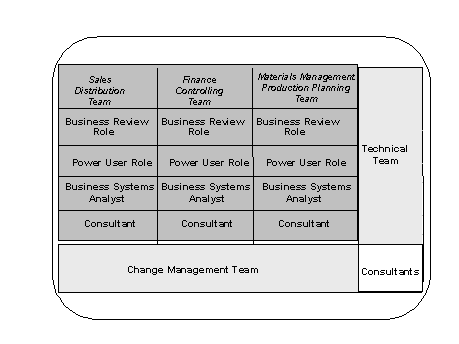
Figure 3. Project Team Composition
NIBCO associates on the three business process teams played the following roles:
Wilson led the Technical Team of IS specialists, which
was responsible for designing and building the new client/server
infrastructure as well as providing ABAP programming support, PC training, and
help desk support. The new infrastructure would link more than 60 servers and
1,200 desktop PCs (with standardized email and personal productivity tools) to
a WAN. Almost every existing PC was to be either upgraded or replaced, and the
WAN would be upgraded to a frame relay network that would link headquarters
with all North American plants and distribution centers. New technical
capabilities would also be required for the product bar-code scanning and
labeling functions that were to be implemented as part of the warehouse
management changes.
Jim Davis led the three-person Change Management team. A public relations manager, Don Hoffman, served as the project team's communications/PR person. Steve Hall, an environmental engineer, was responsible for ensuring that all team members and users received the training they needed. Davis had witnessed some training that Hall had done and selected him to lead the training effort for the project.The R/3 package was to be implemented in a "vanilla" form with essentially no customization. The intent was not to try to reconfigure R/3 to look like the old legacy systems. Rather, the company would adapt to the R/3 "best practice" processes.
We felt like SAP had enough functionality within it that we could make, by and large, the choices that we needed to configure the system to accomplish those high-level goals…. We would identify what core processes we would need, we would look at the choices within SAP, we would pick the one that most closely mirrored our need, and we would adjust to the difference…. To find the best business people for the TIGER team, the three co-leads brainstormed with executives and managers to identify a list of 50-60 NIBCO associates who had the skills and competencies needed; the project would require almost half of them. A Human Resources representative interviewed the candidates with Jim Davis and helped to develop personality profiles, including personal ability to lead, and adapt to, change and emotional fit. At some point, the core team would need to put in long hours, seven days a week.We had to have some senior-level business people who could make the call on those business decisions: how would we configure and why, and what would we let go of and why…. We did not have a situation where we had to go ask permission; we had a situation of continuous communication and contact [with top management].
Jim Davis, Project Co-Lead, Change Management Four director-level leaders were chosen for Business Review roles, including the two leaders for sales and distribution. This meant that 7 of NIBCO’s 28 directors (counting the 3 project co-leads) would be committed full-time to the project. Because the other directors were needed to keep the business running during the project, the remaining Business Review roles were filled with managers who had deep enough business knowledge to identify issues as well as strong enough organizational credibility to settle conflicts as they arose.
Two Business Systems Analysts were on each business process team. As liaisons with the Technical Team, their job was to make sure that the technical implementation matched the business requirements. Because few of the IS personnel inherited by Wilson had the appropriate IT-business skill mix for this type of analyst role, Wilson started early in his tenure to use job vacancies to hire people who could fill these anticipated analyst roles. One of these new hires was Rod Masney, who had worked under Wilson a year earlier in another company.
Early in the project it was decided that the project
team members would be dedicated full-time to the project, but there would be no
backfilling of their old jobs. Team members were expected to remain on the team
throughout the project plus four additional months following the Go Live date.
They would then be redeployed back to business units.
IBM consultants were also assigned to each of the five project teams. The IBM project team members brought their technical knowledge to the project not only so that the business could make smart decisions among the R/3 options, but also for knowledge transfer to the NIBCO core team. Many of these consultants also brought experiences from R/3 implementations at other companies that could be used to help NIBCO avoid similar pitfalls. Consultants from the software vendor (SAP) were also occasionally brought in throughout the project—including BASIS and Security consultants.
Their job was to bring to the table a deep knowledge
of SAP and how it functions and enough business savvy to be able to understand
the business case to help us best configure it in SAP. But we were responsible
for all the decisions. We considered them critical members of the team, not
somebody separate and apart. But our goal all along was that as soon as we went
live, the consultants would go away and we’d manage the business on our own. We
didn’t want to have to live with them forever.
We used the consultants for what we needed them
for—and that was knowledge transfer, extra hands, and technical
skills.
In addition to these formal team roles, Extended Team
Members would be called on to help with documenting the gaps between old and new
business processes and helping with master data loads and testing. Because the
business employees designated to these roles would continue to work in their
business areas during the project, several of them would also be the primary
user trainers in preparation for Go Live. After the cutover, many would also
serve in "local expert" roles.
The project kickoff was September 30th. It
took the company 14 months of planning to get to the kickoff, and the team had
15 months to deliver the ERP system. During the first week, formal team-building
exercises were conducted offsite. During the second week, IBM facilitators led
the entire team through discussions about the kinds of changes the project would
necessitate. For example, team members were asked to think through what it would
mean to change to standardized processes from ten different ways of doing things
in ten different plants with ten different databases. The intent was to
sensitize the entire team to potential sources of resistance and the need for
early communication efforts.
Introductory-level training and training on R/3 modules were held on-site; team members were sent to various SAP training sites in North America for more in-depth, 2- to 5-day courses. Altogether, the team received almost 800 days of training.
VIII. WORKING IN THE TIGER
DEN
Rex Martin was committed to housing the entire project team in a single physical location. The original plan was to move the team to a building across town, but Martin wanted the group to be located closer to NIBCO's senior managers.A major remodeling project was in progress at the headquarters building, and the team was allocated 5,000 square feet on the first floor. Beutler and Davis read books on team management and came up with a plan to configure the space, which came to be called the TIGER Den. The company’s furniture manufacturer designed a movable desk (Nomad), which would enable flexible workspace configurations.
In the end, we were less mobile than we thought we might be, but it created an environment of total teamwork and lack of individual space that forced us to work together and get done what we needed to get done. The Den had no closed doors and no private offices. A large open space called the "war room" had whiteboards on every wall. It was used for meetings of the whole project team, "open" meetings with other NIBCO associates, system prototyping and for core team training during the project. Beutler and his administrative assistant, the change management team, and the IBM project manager used an area with a six-foot partition, that had a U-shaped conference table and workstations. Wilson kept his office within the IS area in another section of the same building, but spent about 40% of his time in the Den.Jim Davis, Project Co-Lead, Change Management Each business process team had its own small "concentration" room for team meetings. They configured their Nomads in different ways, and each team’s space took on its own personality. There was also another open space where Extended Team members could work and that could be reconfigured as needed.
At one end of the tiger den was a room with soft couches and chairs designed to facilitate informal meetings. It was also used for formal meetings as well as celebrations around significant project milestones or team members' birthdays.
Because up to 70 people could be working in the Den at the same time, phones would have been very distracting. The administrative area had a few phones for outbound calls only, and all team members were given private voice mailboxes and pagers; their pager alerted them when a message went into their voice mailbox. A bank of phones was installed in a small hallway leading out of the Den, and emergency numbers were given to family members.
The directors on the project team were used to having private offices, so working without privacy in an open arena alongside the rest of the team took some adjustment. They were told: "Here's a chance to 'live' change management."
During the initial months of the project, the co-leads worked with the IBM project leaders to hone in on the scope, cost, and magnitude of the project in order to develop a final project plan with a realistic budget. In early December 1996, the final project scope and resource estimates were presented to the ELT and the Board, based on a Go Live date 12 months later.
The final project budget was estimated to be $17 million, which was 30% higher than the mid-summer estimate. One of the major reasons for the significant increase was the inclusion of change management costs (including training) that had been missing from the summer budget. About one-third of the final budget was for technology infrastructure costs, including the R/3 software. Another third was for team costs and the education of NIBCO associates. The final third was for third-party consulting.The December plan also addressed two major changes in project scope. One was a recommendation to include North America only. For example, sales offices outside of the U.S. (such as operations in Poland) would not be included in the Big Bang implementation.
A second scope change was driven by technology issues. At the end of 1996, NIBCO had 17 distribution centers, but its long-term strategy was to consolidate to at least half that number. An R/3 project involving 17 distribution centers would have high technology installation and operations costs as well as high project complexity due to the sheer number of locations. A distribution center consolidation prior to the ERP Go Live date would therefore reduce both technology costs and implementation complexity.
Although the detailed planning for the distribution center (DC) consolidation was not complete when the final project plan was presented to the Board, by March 1997 the company had committed to consolidate from 17 small DCs to 4 large ones: 1 existing facility would be enlarged, and new managers and associates would be hired to run the 3 new DC facilities. The goal was to complete the consolidation by September 1997 to allow time to prepare for the cutover to the ERP system.
SAP provides opportunities for consolidation, so it's not uncommon for companies to decide on a certain amount of consolidation for something… The original timing had the warehouse consolidation getting done ahead of SAP by a couple of months. There were several major business risks associated with the project that also would have to be managed. First, the integration really had to work, because otherwise any one part of the organization could claim that they were no better off, or even less well off, than before the project. This meant the team would have to make decisions focused on the integration goals, which would result in killing some "sacred cows" along the way.Gary Wilson, Project Co-Lead, Technology Second, the company could be significantly harmed during the project because most other company initiatives would basically be put "on hold." The exception was the distribution center consolidation, and this would involve large-scale personnel changes and increased demands for training. At the same time, it would be important to maintain as much customer satisfaction as possible.
Management also knew that if the project ran late, it could really hurt the company. So the project had to be completed on time with a quality result.
You can't pull 27 full-time people out of a business that runs fairly lean, and then not backfill and expect business to go merrily on its way. We actually watched one competitor of ours go live with SAP during the course of our implementation, and the first two weeks they were live they could not take a customer order. And so we were seeing some real life horror stories in front of us. So, the risk management from our perspective was: we're gonna 'deep six' this company if we do this poorly or if we don't do it on time. Because there was no back-filling of the jobs held by the project team members, NIBCO associates not on the project team had to take on extra work to sustain normal operations. This meant that the whole organization needed to be committed to the ERP project. An upfront goal of participation by one-third of NIBCO's salaried associates was established to be sure they understood where the project was going, to promote buy-in, and to get the work done.Jim Davis, Project Co-Lead, Change Management There was a team of people who were living and breathing it everyday, but it truly was a whole company effort. I had 2 individuals that left my organization and were full-time members of the team. We did their work; we absorbed it. That was universal throughout the company. A few months after the project began, a special incentive pay bonus was established for every salaried NIBCO associate. The bonus was tied to a half-dozen criteria (Table 2). The Go Live schedule had to be met, or no incentive pay would be distributed: a 30-day grace period, only, would be allowed from the original date set, which was the Monday after Thanksgiving (November 29th). The incentive pay pool would be reduced by 50 cents for every dollar over budget. Four overall project "success" criteria were also established, along with specific measures. The results of these measures would be available for review by the ELT within two months after implementation, and the Board would make the final decision as to whether or not these results collectively met the success criteria.Diane Krill, Director, Customer and Marketing Services Table 2: Criteria for Incentive Pay
| CRITERION |
|
INCENTIVE PAY |
|
|
SAP must be live on or before 12/31/97 | Required for any incentive pay |
|
|
1. Client-server
environment measures: - available 90% of agreed upon time - 95% of real-time response times are less than 2 seconds |
Executive Leadership Team will review the results of these four measures and make a recommendation to the Board as to whether or not project was a success |
| 2. Business
processes supported by SAP: - one day after Go Live, no transaction data entered into legacy systems - 45 days after implementation, less than 15 open data integrity problem reports |
||
| 3. Core
management and administrative processes supported by SAP:
- close books through SAP within 15 days at first month end |
||
| 4. Training of
NIBCO associates in use of SAP and processes: - a minimum of 95% attendance at training classes across the organization |
||
| WITHIN BUDGET | Control spending to at or below project plan approved by Board 1/28/97 | Every $1 over budget reduces the incentive pool by 50 cents |
Stock options were also granted to all core team members
in April 1997 as a retention incentive.
The project was conducted in four large phases: Preparation, Analysis, Design, and Implementation (Table 3).Because few tools were available for purchase, the IS team built a number of tools to help with process scripting as well as project management. For example, Project Office was a NIBCO-developed tool for project management and project tracking that used an Access database (MS Office 95). Project Office became the repository for all project planning documents, as-is and to-be process scripts, tables to support the documentation for the project, testing plans and results, site visit and training schedules, issue logging, etc. The sales order processing script, for example, consisted of more than 100 pages of detailed documentation, and was used as the basis for classroom training documentation. This tool allowed team members to access the latest project documents and to gauge where they were in relation to the project's key milestones.
Due to the time demands of the project, all team members were provided with laptops so that they could work 24 hours a day, 7 days a week, from anywhere they wanted. Because there was no support for mobile (remote access) computing prior to the TIGER project, providing anytime/anywhere support was also symbolic of NIBCO's commitment to helping its employees leverage their time better using information technology.
Table 3. Implementation Phases
|
|
|
|
|
Final project
plan – scope and cost.
"As-is" business analysis. Technical infrastructure specifications. Project management and tracking tools developed. |
|
|
Document "as-is"
processes as "to-be" processes.
Analyze gap between "to-be" processes and R/3 processes. Identify process improvements and changes to fit R/3. Documentation of inputs, outputs, triggers, business activities, (process) roles, change categories, training requirements. |
|
|
Configure
R/3.
Develop training materials. Develop and document specifications (master data, external systems interfaces, reports) Develop prototypes:
|
|
|
Some overlap
with Design Phase.
New tactical teams formed with directors heading up risky areas:
|
FINANCE AND CONTROLLING TEAMMATERIALS MANAGEMENT/PRODUCTION PLANNING TEAMThe Business Review lead for the Controlling function was Steve Swartzenberg, who had spent more than five years in different plant positions, starting as an industrial engineer and working his way up through plant administration; he had recently been promoted to product manager. During the project Swartzenberg worked not only with his current boss, the VP of Marketing, but also with the CFO—because the tactical managers of the new Controlling module would be controllers within the Accounting/Finance group.
My Business Review role responsibility was to make sure that the functional organizations who would be taking ownership for the Controlling module, once we turned it on, were pulling for it. I kept them up to speed on how we were doing on the issues, on the things they needed to help with along the way, so that they knew what their role was to hit each of these critical milestones. None of us wanted to not make it, so we knew how it had to knit together—we knew our job was to hit the milestone. There were two IBM consultants on the Controlling team. One helped with the Controlling (CO) module functions of product costing, cost center accounting, and internal orders; team members relied on this consultant to answer detailed questions about what the package could and could not do. The second consultant supported the team on the profitability analysis (PA) and profit center accounting (PCA) sub-modules. When the second consultant left the project, Swartzenberg helped select a replacement who not only understood R/3 details, but also had a strong financial background.Steve Swartzenberg, Business Review Lead Not coming from accounting, I kind of used him as my accounting consultant—as a kind of sanity check…. The controlling module in SAP really is the spot where it all comes together. What you find out is no part of the organization is disconnected from another. It's all connected; the processes are all integrated. If one part falls out, it doesn't link up. Steve Swartzenberg, Business Review Lead
A major business process change would be to centralize all accounts payable entries that had been decentralized to the plants in the past. Swartzenberg spent extra time developing documentation that included flowcharts and other tools to help with the transition. For example, a check-and-balance process was designed for looking at transactions in specific areas where problems would first be visible. The Accounting group did these checks every day for the first month after Go Live so that problems could be fixed as they happened, and to avoid snags at the time of the first financial close.An Extended Team member from marketing helped develop profitability reporting (P&L's) for each of the product lines—copper fittings, cast fittings, plumbing, and heating valves, etc.—information that was not available under the old systems.
The Business Review lead for the manufacturing Production Planning (PP) module was John Hall, a 20+-year veteran at NIBCO. Hall had been a member of the BCG study team and was involved in the decision to take the Big Bang approach. Six months prior to the TIGER project kickoff, Hall had become Director of Plastics manufacturing.
One of the two Power Users on the PP team was Jan Bleile, a 25-year NIBCO
veteran in production control who had worked on the manufacturing legacy system
(Man-Man) and its predecessors. He also had a good rapport with all the
old-timers in the plants.
From the outset, there were concerns about all the changes that would need to take place to implement both new processes and new systems at the plants. Hall worked with other manufacturing directors, the VP of Manufacturing, and Scott Beutler to set up 3- to 4-day meetings with TIGER Team members at every plant during December 1996. At these meetings the core project team emphasized that R/3 was the system that would be used at all plants, and that all data would reside in it. In turn, the team learned how things were done in each of the plants, including what each plant thought it did that was unique.SALES/DISTRIBUTION TEAMAlthough it was not initially clear whether common processes could be implemented across all NIBCO plants, the project team was able to reframe each plant's tasks into high-level generic processes. The idea was to keep things relatively simple at first. Then, as people became comfortable in using the system, the number of complex features and functionality could be increased. The project team then gained consensus for this common way of doing things, plant-by-plant—whether the manufacturing process was for plastics, copper, foundry materials, etc.
We kept pounding the message home that you don't have to believe us, but just give it a try, and do it with an open mind. Every time someone would call and say, ‘We can't do this, we're different, we need this, we need that’ we would say ‘you're not going to get it, so you've got to give this a try’…. Just having the CEO as the major champion helps overcome any and all obstacles you can think of. Extended Team members for the PP module were formally designated early on. Although they resided at the plants, they also spent time in the TIGER Den at headquarters learning about the master data plans and the impacts of real-time on-line processing. Through these in-person interactions, the project team members learned what process changes would need to be emphasized the most when the plant workers were trained. During the final months of the project, many of these Extended Team members dedicated 100% of their time to conducting training classes at different facilities. Every NIBCO associate who would need an R/3 license was signed up for a certain number of classroom training hours.Jan Bleile, Power User The Business Review lead for the Materials Management module left the company in May 1997. Although this event was viewed as "positive" overall (due to internal team conflicts), it also left a major gap. Because this happened so late in the project, John Hall took on this role as well, with help from Beutler.
Several major process changes were also to be implemented for these functions. First, customer accounts (which accounted for a large percentage of sales) would have dedicated NIBCO associates. Second, a much more controlled processing environment would be set up for making changes to customer master data. In the past, changes to customer data, including pricing data, could be made by all Customer Services (CS) personnel. Under SAP, a new, centralized Marketing Services group would be formed and customer master data changes would be limited to this group. This more centralized, focused approach would yield revenue gains from better response to national accounts. It would also yield dollar savings because fewer price deductions would have to be given to customers due to internal processing errors.One of the major challenges facing the project team was the structuring of the customer master data. For example, terms of sale at NIBCO had not been defined in terms of the sales channel of the customer in the past, but in R/3, pricing distinctions are made between wholesalers and retailers. This meant that all NIBCO customers had to be classified by their sales channel. Training was also a major hurdle because about half of the CS staff had used green screen terminals in the past and had to be trained in using a PC with a mouse and graphical user interface (Windows). PCs for the CS group were installed about eight months before the Go Live date, and each member of this group had over 45 hours of mandatory R/3 training.
NIBCO's warehouse operations had not been highly disciplined in the past, so large-scale process changes would also be implemented for the Distribution function. The risk of the warehouse management implementation was increased by the distribution center consolidation that was going on during the same time period.
We used to run distribution centers with notebooks. John who put stock away, put it over in bin 12 in the corner, and would write it down. He knew where the overstock was and you could get away with that in a 50K sq. ft. facility. But when running 250K sq. ft. facilities, you can't do that; you've got to have a system run your facility for you. Larry Conn, Extended Team Member
During the Preparation phase, while the business process teams worked on as-is analysis, about six IS specialists under Wilson developed a 250-page technical document that became the blueprint for building the new technology infrastructure—the PCs, servers, and networks for every NIBCO location. Over the next nine months, the technical team worked through the installations for all the plants and distribution centers, and a trainer would travel right behind the technical team and do PC and Windows training as needed.The TIGER project and the new client/server architecture also required new work processes for the IS organization. New processes for network management, backup and recovery procedures, system change controls, and business-client relationship management needed to be developed. Many of these changes were made under the TIGER project umbrella, and the IBM consultants helped with the IT process design and IT worker reskilling.
The project leaders worked very hard to manage our consultants. We expanded when we needed to and we contracted very quickly. When a consultant no longer held value for us, we cut him loose. At one time, we counted 50 consultants here. During the Preparation phase, a new director-level position for systems development was filled with an outside hire, Greg Tipton, who began to take over the day-to-day program management responsibilities from Wilson. Tipton became the primary liaison between the TIGER team and the IS development resources during the Design phase as ABAP programming needs increased. All maintenance support for legacy systems was essentially shut down by the summer of 1997 as the entire IS group focused on the R/3 implementation.
Rod Masney, Business Systems Analyst
In the last months of the project, the IS area was running multiple R/3 environments: the development system, a production system, two training systems, and a test system. IS specialists were also dedicated to cleaning up and converting master data, loading master data, and stress testing the system with real data. Data from 85 different legacy system files and lots of Access databases had to be converted. Although discussions on how to accomplish these critical activities began as early as March 1997, the master data loading processes proved to be more complex than expected, and four complete "heavy duty testing" trials were run.
Because IBM’s change management approach was not ERP-specific, the NIBCO
team had to learn how to apply it to an R/3 Big Bang implementation. Some of the
IBM change management people had been trained in methods developed by Daryl
Conner, CEO of Organizational Development Resources, Inc. Conner’s book (Conner,
1992) heightened the leadership team's understanding of the importance of
dealing with change management issues at the level of the individual. The
overall change management thrust became how to ensure that the R/3
implementation would not drive NIBCO users beyond their abilities to adapt to
change.
Although only Davis and two other team members were working full-time on change management issues, all team members were expected to be change leaders. During the selection process they were told that the rest of the organization would be looking to them to understand where the TIGER project was heading and why it made sense to be going in that direction. The team members also had to understand the change implications of their decisions: they were asked to identify what the major impacts would be for people performing a particular function—how they would work together differently, or need different information. The change management team used this knowledge to develop communication and training plans that would help NIBCO associates make those changes.
Information to help the change management team was captured as part of the business process documentation. For example, as a business process team was preparing "to-be" business process documentation, the team members were asked to identify the changes a given process introduced and to categorize them (Table 4). No process documentation (and later no training script) would be approved until the change management elements were complete.Table 4 Change Management Categories
| New work (New) - The purpose of this category is to
highlight where a new job is required. Please reference which role
(responsible, accountable, consulted or informed) you are referring to and
any details about the job you think would be useful in defining or
designing the new job. (Example: Master data is going to be managed and
controlled in a centralized location. This would require the creation of a
new job which is focused solely on this set of activities.)
Automation of old work (Automate) - This category should be used when an activity which was previously performed manually will now be automated either in whole or in part. Please note whether this activity should still remain in the same functional area or whether the automation would support its movement to another functional area. (Example: The system will automatically perform the 3-way match of a PO, receiver and invoice which we currently reconcile manually.) Elimination of related activities - (Eliminate) - This category should be used when activities previously performed associated with this activity are no longer required because of a changed process. Please note which function previously performed this eliminated work. (Example: People spend significant time creating special reporting to summarize data in a meaningful way for analysis. The system will provide that data on-line in a way which allows the analysis to occur without the off-line work.) Work moved from one group to another (Transfer) – Transfer should be used when work moves from one function/department to another or when work is moved up or down from one level of management to another. The goal for this element is to track how you expect work to shift as a result of the new activity or process. (Example: Accounts receivable activities occur as a part of the Customer service function because of the need for communication with CSR’s. The system will now provide information in a way that allows the A/R activities to be performed in the Treasury area.) Risk of process not being done well (Risk) - It is important that all new processes be performed efficiently and effectively. This change element should be used when the activity is particularly critical to activities performed downstream and you want to highlight that to the organization. (Example: The new demand pull methodology has a particular "triggering event" which drives all of the downstream events. It is imperative that this activity is performed effectively, or in a particular time frame, or with a particular frequency.) Increased level of difficulty (Difficulty) - This category should be used when a new activity or process is substantially more complex or involved than previously. This will give us a heads up for training and organizational readiness to prepare for a more difficult application. (Example: The current process calls for data to be input without any quality review or analysis. The new process requires a specific analysis to be performed or data to be reviewed and approved prior to entry into the system.) New business partnerships (Relationships) - This category should be used to identify where the new activity or process requires people to work together or collaborate in new ways. This could include where information must be shared between groups that don’t ordinarily work together. (Example: I currently work with the logistics function to get input for an activity I perform. In the new process, that information will come from manufacturing.) Miscellaneous (Other) – Other should be used when you want to highlight an issue or concern that is not covered by one of the other change categories. |
For example, an associate in accounts payable who worked with NIBCO's legacy systems in the past really had no need to talk to the procurement department. But in R/3, the procurement process has a significant bearing on the transaction documentation that finds its way to accounts payable. So the communication and information sharing between those two groups becomes very important. The change category here would be Relationships.Team members were also asked to help determine the training needs for these specific change examples. In all, 450 different business activities in 15 locations had to be addressed.
INTERNAL COMMUNICATION PLANA critical part of the change management efforts was to provide information and to keep open the communication lines between the project team and the other NIBCO associates. This involved several types of activities—some at headquarters and some on-site at the plants and distribution centers across North America.
We basically followed the rule…somebody has to hear something five different times from three different sources for it to hold. So we looked for every different way that we could get ahold of somebody to get their input and to share information with them, too. A communication analysis of three or four hundred people at NIBCO yielded a type of "spider web" map of internal communication linkages from which the "best connected" associates could be determined. The supervisors of people with a score above a certain level were then asked for permission to invite these people to participate in a TIGER Focus Group. About 15 people at corporate, and 3 to 6 people at each plant and distribution center, were then personally invited to join the Focus Group. Their job was to be a "hub" within the business, to provide bi-directional feedback, to the team and to those with whom they were connected in the workplace.Jim Davis, Project Co-Lead, Change Management We didn't say: ‘You have to be a cheerleader for the project.’ As a matter of fact we said: ‘We prefer that you fight back because it is only at the point of resistance that we can identify how to react’….Their job was to get in our face and say: ‘You know what? You've got a deep problem—people are just not buying into this.’ Or: ‘Here's where you're gonna fall off the edge.’ Another key communications activity was holding monthly "TIGER Talks" in the auditorium at corporate headquarters. Jim Davis and selected TIGER team members made presentations and answered questions, and Don Hoffman facilitated the meetings. Each TIGER Talk had a different main message, such as project phases, process-focused organizations, training and education plans, technology infrastructure, plans for prototype sessions, organization/role/job design, implementation phase issues, "home stretch" issues, SAP start-up plans, and post-live status.Jim Davis, Project Co-Lead, Change Management These face-to-face sessions were open to all NIBCO associates; each session was run four times, so that people could pick a time slot to fit their schedules. Attendance was voluntary, but there was an expectation that members of the Focus Group would be among the attendees. A summary and internal news release highlighting the main message were published to the entire organization within 48 hours. On a monthly basis, information would be sent out to Focus Group members and other key players who were not at the meeting, and videotapes of the sessions were also made available.
Team members also conducted two or three rounds of on-site visits to each NIBCO plant and distribution center. That meant that all associates had an opportunity for a physical face-to-face meeting with team members once every three to four months. Again, questions and answers from these meetings were summarized and distributed within 48 hours to the entire organization.At each meeting, the team attempted to measure the level of individual commitment to change. A change adoption curve was posted on a flip chart and the meeting leaders pointed out that their goal was to get every NIBCO associate to the buy-in point on the curve. Each participant was given a red sticker and asked to place the sticker on the curve to record "where they were" at the end of each meeting, out of sight of the TIGER Team members. Over the course of the project, these scattergrams became a way to measure progress toward an effective implementation. The team could also identify which plants or distribution centers were lagging behind, and then focus on the ability of those associates to assimilate the anticipated changes.
About halfway through the project, a weekly newsletter for those associates who would be using R/3 began to be distributed via e-mail. After training had begun, the newsletter included questions asked in the training classes and the answers provided by the classroom trainers.
USER TRAININGOver 1200 hours of training were delivered at 3 NIBCO training sites over the 4-month period before Go Live. Depending on their job, users received between 8 and 68 hours of training that focused on the new processes, not just individual tasks. In addition, a user ID was issued during the training classes that entitled associates to access a training "sandbox" where they could try things out and practice transactions or scenarios. User attendance at the training sessions was tracked as part of the organizational incentive scheme, but sandbox practice was not.
XIV. DELAYING THE ‘GO
LIVE’
The original plan was to Go Live the Monday after Thanksgiving. This date proved to not be feasible for two primary reasons.First, the distribution center consolidation was significantly delayed. This resulted in a somewhat chaotic state, as most of the DC managers were still focused on the consolidation, rather than on preparations for the R/3 system. The new staff hardly had a chance to get to know NIBCO's business partners, let alone be prepared for a new system by the Go Live date.
Second, a complete master data load was taking about 17 to 18 days round-the-clock. The first loading of the master data for manufacturing was sufficiently bad that the consultants had warned them that they were "in trouble." The manufacturing data alone was loaded six times. A "stress test" at the beginning of November also reinforced the need for another "full load" test, and time was running out. These new people who were in all the new facilities never had time to get involved in the SAP project. They never went through appropriate training because they were focused on the consolidation. You cannot do two astronomical projects at the same time. Distribution was not prepared for the SAP start-up and we paid for it. Larry Conn, Extended Team Member We were probably right out there at the maximum extreme as far as time to get something like this done. There were other small companies out there that had done it in like 6 or 7 months where they just slammed it in. We didn't buy into that. We had a ton of master data to move around, which was a big deal for us. It was a major, major effort that slowed us The Go Live date was moved back to the latest possible date—the end of the 30-day grace period. The change management team used the project delay to emphasize scenario training that focused more on business process changes. Although the attendance at training had been very high, there was no formal user certification process and user readiness continued to be a concern.Scott Beutler, Project Co-Lead, Business Process
On the Go Live date, there were no consultants on site. Instead of paying the consultants to come in for two days in the middle of a holiday week, they were "cut loose" for the last week in December. Management knew that even if they struggled for those two days, they would be bringing the system back down and would have time to work on it over the New Year's holiday weekend to make any fixes. Core team members were on-site at plants out in the field, and a help desk was manned by project team members. Besides saving some consultant costs, it was a symbolic move: the company was ready to operate R/3 on its own.The co-leads had warned the business that "it was going to be ugly" in the beginning. Everything they had read and heard suggested that there would be an initial drop in productivity. The key was not to deny it, but to plan for it and manage through it. On Day 1 they were prepared to be able to operate at only the 50% level.
The project team members were kept on the team for only two months after the Go Live date, rather than four months. The business units were clamoring for people to come back, and just didn't want to wait any longer.
Ideally, we should have had them for another 60 days because we went through a lot of growing pains, and we could have done much better if we had the team together longer. But…it was unraveling on us and we just had to let people go. By the time they went live, most team members knew where they would be redeployed. Some went back to their old jobs, but several received promotions or new opportunities and many went into newly created jobs. Some of the Extended Team members found that their business groups continued to rely on them for their in-depth R/3 knowledge. A few of the Power Users went into SAP support positions within the IS organization.Jim Davis, Project Co-Lead, Change Management END NOTE
1Michael Hammer was a reengineering guru beginning in the early 1990s (Hammer and Champey, 1993)Author’s Note: Copies of the teaching note can be requested by email from the following address: mailto:iuerp02@aol.com
The teaching note includes an epilogue, a framework for analyzing the implementation approach, a teaching guide, and supplementary references.
The authors are indebted to Gary Wilson, Scott Beutler, and Jim Davis, who generously shared their time and insights, as well as all of the other NIBCO associates who were interviewed by the authors. The receipt of an SAP Research grant from the Indiana University Kelley School of Business to support this research project is also gratefully acknowledged.
Daryl R. Conner (1992) Managing at the Speed of Change. New York, NY: Villard BooksM. Hammer and J. Champy (1993). Reengineering the Corporation: A Manifesto for Business Revolution. New York: HarperCollins
Carol V. Brown is Associate Professor of Information Systems at the Kelley School of Business of Indiana University, where she currently teaches courses on IT management. From 1998 to 2000 she served as the VP for Academic Community Affairs on the Executive Board of SIM International. She is currently an officer of the SIM-Indianapolis Chapter. Her Ph.D. in MIS is from Indiana University.
Carol's research interests are on IT management and organization topics. In addition to research articles published in leading MIS and management journals, she has published a monograph on Repositioning the IT Organization to Enable Business Transformation (with V. Sambamurthy, Pinnaflex, 1999). She is also the co-author of an IT management textbook (Prentice Hall) and the editor of the 7th edition of Auerbach's IS Management Handbook. The NIBCO teaching case grew out of a larger research investigation on ERP adoption and implementation issues.
Iris Vessey is Professor of Information Systems at Indiana University’s Kelley School of Business. Iris is recognized for her research into evaluating emerging information technologies, from both cognitive and analytical perspectives. Much of her research has assessed the unsubstantiated claims for the efficacy of new technologies that abound in the popular press. Her research on cognitive fit has been featured in the Wall Street Journal and that on software tasks in InformationWeek, Computerworld, and IEEE Software. Iris was recently ranked as one of the top ten IS researchers during the period 1991 to1996. Her current research focus is on enterprise systems (ES) from the perspectives of both adoption and implementation. She is an inaugural Fellow of the Association for Information System.
Copyright ©2001, by Carol V. Brown and Iris Vessey This case is reprinted in CAIS by permission of the authors. Permission to make digital or hard copies of all or part of this work for personal or classroom use is granted by the authors without fee provided that copies are not made or distributed for profit or commercial advantage and that copies bear this notice and full citation on the first page. Abstracting with credit is permitted. To copy otherwise, to republish, to post on servers, or to redistribute to lists requires prior specific permission and/or fee from the copyright holders. Request permission to publish from Carol Brown ( cbrown@iupui.edu ) or Iris Vessey ( ivessey@indiana.edu )

ISSN: 1529-3181
EDITOR
Paul
Gray
Claremont Graduate
University
| Henry C. Lucas,
Jr. Editor-in-Chief New York University |
Paul
Gray Editor, CAIS Claremont Graduate University |
Phillip
Ein-Dor Editor, JAIS Tel-Aviv University |
| Edward A.
Stohr Editor-at-Large New York University |
Blake
Ives Editor, Electronic Publications Louisiana State University |
Reagan
Ramsower Editor, ISWorld Net Baylor University |
| Gordon
Davis University of Minnesota |
Ken
Kraemer University of California at Irvine |
Richard
Mason Southern Methodist University |
| Jay
Nunamaker University of Arizona |
Henk
Sol Delft University |
Ralph
Sprague University of Hawaii |
| Steve
Alter University of San Francisco |
Tung
Bui University of Hawaii |
Christer
Carlsson Abo Academy, Finland |
H. Michael
Chung California State University |
| Omar El
Sawy University of Southern California |
Jane
Fedorowicz Bentley College |
Brent
Gallupe Queens University, Canada |
Sy
Goodman Georgia Institute of Technology |
| Ruth
Guthrie California State University |
Chris
Holland Manchester Business School, UK |
Jaak
Jurison Fordham University |
George
Kasper Virginia Commonwealth University |
| Jerry
Luftman Stevens Institute of Technology |
Munir
Mandviwalla Temple University |
M.Lynne
Markus Claremont Graduate University |
Don
McCubbrey University of Denver |
| Michael
Myers University of Auckland, New Zealand |
Seev Neumann Tel Aviv University, Israel | Hung Kook
Park Sangmyung University, Korea |
Dan
Power University of Northern Iowa |
| Maung
Sein Agder College, Norway |
Margaret
Tan National University of Singapore,Singapore |
Robert E.
Umbaugh Carlisle Consulting Group |
Doug
Vogel City University of Hong Kong, China |
| Hugh
Watson University of Georgia |
Dick
Welke Georgia State University |
Rolf
Wigand Syracuse University |
Phil
Yetton University of New South Wales, Australia |
| Eph
McLean AIS, Executive Director Georgia State University |
Jennifer
Davis Subscriptions Manager Georgia State University |
Reagan
Ramsower Publisher, CAIS Baylor University |