What do you do if your enterprise app vendor goes
under?
Oct 27, 2000
Matthew Osborn
Although it is highly unlikely that
SAP, Oracle, or PeopleSoft is going to cease operations, many organizations are
looking for ways to protect their enterprise resource planning (ERP) investment
in case application support becomes unavailable. As a senior IT strategist, you
are responsible for developing a contingency plan in case that should happen.
Industry experts suggest that your contingency plan address these questions:
- How is vendor viability calculated?
- How far into the future should your contingency plan cover?
- Should a code escrow agreement be included in your contingency
plan?
What should a contingency plan
include?
"Users should have identified resources that can provide
support if the software company goes under. Usually, as a company nears the end,
groups of employees or third parties seize the opportunity and will provide
different types of services, from enhancements to education to consulting," said
Sharon Ward, director of enterprise business applications at the Hurwitz Group. "It's important
to have these resources in place and to know the specific services they can
provide. It might also be a good idea to cultivate a strong relationship with
key employees of the vendor who are instrumental to your implementation,
ensuring that they keep in touch should circumstances change. They may be
willing to do some work on a contract basis even if they are employed
elsewhere."
| Key components of a contingency plan |
- Keep documentation updated
- Outline likely scenarios
- Determine probability
- Establish countermeasures
|
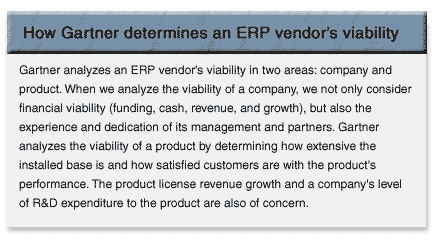
How do you determine vendor viability?
Vendor viability
can be difficult to assess. "Vendor viability is hard to evaluate from the
outside. Support contracts and services revenue often mean that vendors take a
really long time to show problems, and you can be caught unaware if you're not
looking at the detail. Evaluate your vendor's viability not just on total
revenue. Dig into the numbers," said Ward.
Ward recommends that you
answer the following questions when determining vendor viability:
- How much is new license revenue to new customers, not just add-ons to
existing customers or revenue from services and support?
- How many new customers did they actually acquire?
- How much advertising are they doing? More or less than in the past?
- How much press attention are they getting?
How far out should you
plan?
"We [Gartner] recommend three to five years out, but it depends
on where you are in the life cycle of an ERP," said Gartner ERP analyst Chad
Eschinger. (TechRepublic is an independent subsidiary of Gartner, an IT
consultancy based in Stamford, CT.) "If you are just implementing the
application, then you want to have a three- to five-year plan. If you are at the
end of the application life cycle, meaning the end of core usefulness, you
should have a plan for four to five years out," said Eschinger.
Are code escrow agreements effective protection?
A code
escrow agreement is formed when you and the software vendor agree to deposit the
application's source code in a third-party, neutral depository. The agreement
calls for code and documentation to be made available to the purchaser in the
event that the vendor can no longer provide services.
If your application
is mission-critical, then a code escrow agreement may not offer the type of
protection that your organization needs. "They [code escrow agreements] are good
if you've been sleeping, and the vendor completely disappeared while you weren't
looking. It takes so long for most vendors to actually disappear because of
service and support revenues that if you're caught unaware, you should be
ashamed," said Ward. "An escrow agreement will only come in handy if you need to
extend the life cycle of your existing implementation beyond the two years of
your contingency plan. If you're paying attention to the signs, you'll have more
than that time before the vendor goes away completely."
Ward points out
that if the application has been modified, then code escrow agreements are even
less effective. "They're almost totally useless if you've done modifications,
because those are rarely well-documented enough to be retrofitted to the
'vanilla' escrow source without major headaches. In most cases, you'd be better
off devoting those resources to finding and implementing your next-generation
solution," said Ward.
| More on code escrow agreements |
| Check out these articles for more information on code
escrow agreements:
|
| Tell us what you think |
| Do you have a contingency plan formulated in case your
app vendor goes under? Drop
us a note, or start a discussion below. |
Copyright © 1999-2000 TechRepublic, Inc.
Visit us at http://www.techrepublic.com/