IS 483 IS Management Session 10 Commentary
Agenda
Submit Final Exam
Course Summary
The Nature of IS Management
The Role that Technology Plays
The Role that History Plays
Leading People and IS-HR
IS -- structural patterns
Distributed Architecture
Operations
Training / Help Desk
Outsourcing
Risk Management
Procurement
Break
Reconsider:
Financial Analysis
Costs and Benefits Review including the Statement of Work (see Contract Negotiation)
Cost Benefit Analysis
1. Break-even analysis
2. Payback analysis
3. Cash-flow analysis
4. Net Present Value (NPV) analysis
Capital Budgeting -- depreciable assets and their return over long periods of time.
Remember:
probability of an event occurring + probability of an event not occurring =
1
so if probability of rain
is .8
then probability of no
rain is .2 or 1- .8
Course Summary (A META view)
|
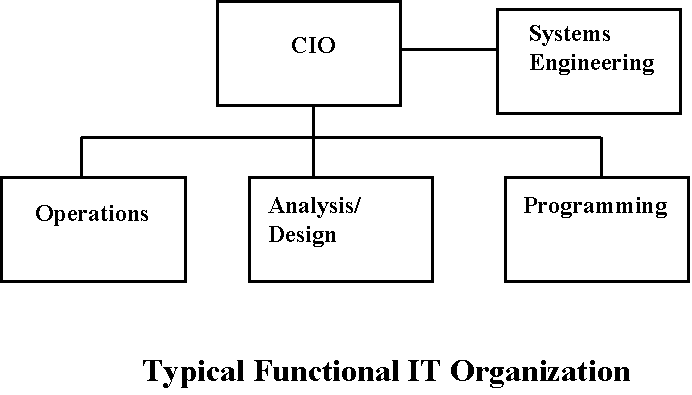
IT Function
>> |
Analysis / Design |
Programming |
|
V V |
||
|
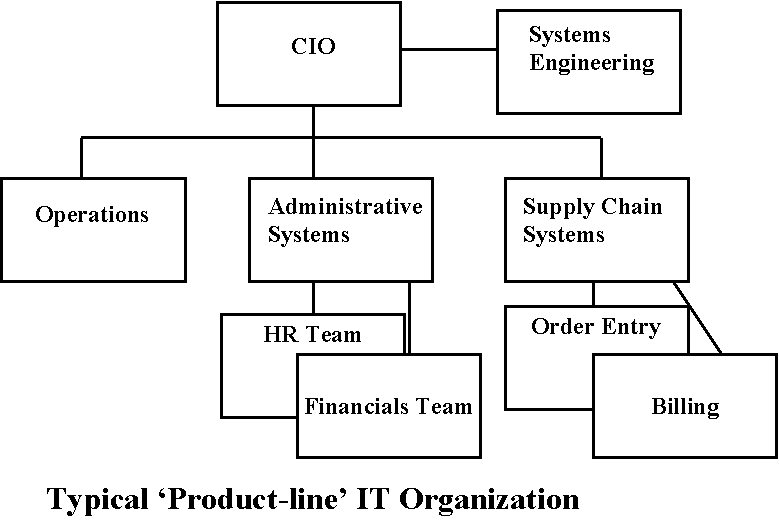
Administrative |
Analysts |
Programmers |
|
Supply Chain |
Analysts |
Programmers |
Typical 'Matrix' IT Organization
Some Functions/Tasks Handled in IT Organization
Break
Financial Analysis
Analysis Methods are based on the-
'Statement of Work'
--
an agreement between firm and vendor
--includes:
Software Performance
Description of software
Detailed explanation of required customization
3rd party products
Standard and Ad Hoc Reporting
Implementation
Project team structure
Staffing assumptions
Implementation methodology
Technical Architecture
Infrastructure
Data Conversion
Training Strategy
plans
resources
Maintenance and Support
on-site, online support
interface with legacy systems
future upgrades
Cost Schedule
detailed cost schedule by category and software; other costs
five (?)year schedule
| Situation in Statement of Work | Analysis Method |
| project justified in terms of costs, not
benefits or benefits will/should not substantially improve with project |
1. Break-even analysis |
| project improves tangible benefits | 2. Payback analysis |
| project is expensive relative to firm size &/or large drain on funds | 3. Cash-flow analysis |
| payback period is long or cost of borrowing money is high | 4. Net Present Value analysis |
Financial Analysis
1. Break-even
Analysis
---- justification from costs (reduction usually on unit costs but can also
reduce fixed costs)
not looking at the
benefits improvement (usually in IS benefits equate to improving
capabilities),
that is, benefits
will/do not substantially improve with the proposed system
---- compares total costs against
growth in volume
The break even point is when the total cost of the current system and proposed
system intersect,
at this point the project becomes "profitable"
Pro -- useful when business is growing, volume is a key variable in cost
Con -- because benefits are not considered and therefore assumed to remain the
same under any new alternative
a new alternative
that has a combination of benefits improvement with a less robust costs
structure
improvement must
not get approved because the more robust cost structure improvement alternative
looks
better
Example:
Current payroll system costs $1.25 /ee to process an employee for a
payperiod with 2000 employees.
New system will process up to 4000
transactions per period at the cost of $.35 /ee and costs $20,000 up front
(fixed cost).
Payroll is
processed weekly.
TCold = Total Cost of running old system
Q = number of employees processed / period = 4000
TCnew = .35Q + 20,000
TCold= $1.25Q or 1.25*2000= $2500 for each pay period
Breakeven is when old costs = new costs therefore: TCold = TCnew
.35Q +20000 = 1.25Q
20000 = 1.25Q - .35Q
20000 = .9Q
22222 = Q
or Q = 22,222 employees or at the point where
22,222 employees have been processed, the costs of the new
system are same as for the old system
22,222/2000rounded up
= the number of the pay period in which breakeven occurs
or in the 12th pay period
the break-even point is reached.
2. Payback
Method -- justification from improved
tangible benefits
---- assess the worthiness of
alternative investments in terms of time
---- length of time it takes for the benefit of the system to payback the cost
of developing it.
---- determine the period of time in which the system must operate so its
benefits payback
the cost of investment.
---- Payback Period = Investment required / net annual cash inflow (that is, the
benefits)
Pro -- gives the minimal period of time the system
needs to be in operation to have system make "sense."
Con -- short term approach on investment & replacement
-- does not consider how repayments are
timed
--
does not consider total return beyond
the payback period
-- does not consider cost structure
improvements
Example
A new b2b system handles 1000 sales per day averaging $50 net per sale
(after taking
out the increased costs for
running new system on existing equipment) and
which
could not occur without this new system
or
$50,000 per day after paying the variable costs.
New system costs $300,000 to
develop.
The payback period is 300,000 / 50,000 = 6 days for payback.
3. Cash Flow
Analysis --
project is expensive relative
to firm's size,
or when firm can be significantly affected by large drain of funds
---- assess the direction, size and
pattern of cash flow (both inflow and outflow).
If no revenue, then only
measure the cash outlays with inflows remaining zero
---- when will project begin to make profit or out of the red?
---- examines the direction, size
and pattern of cash flow associated with the proposed systems
Pro -- gives the firm an idea of when it must add funds to get system
developed and when system will generate funds
-- considers both cash inflows the
new system generates and the cash outflows the new system needs for its
development
and operation
Con -- does not consider the time value of money where
today's money is worth more that tomorrows
expanation: -- cash flow shows the results of that period (Q1-Q5) or cash flowcurrent
= revenuescurrent - costscurrent
-- cumulative cash flow (CUM CF) shows the collective cash spent and received
and its direction
cum cf current =
cum cfcurrent-1 period + cashflowcurrent
Example
The new system requires starts generating new revenues in the first quarter of
its development but there are large outflows from the beginning. By
tracking both, the new system will start generating a profit, that is the
cumulative cash flows become positive in the 4th quarter with 3.79k.
|
|
Q1 |
Q2 |
Q3 |
Q4 |
Q5 |
|
Rev or Inflow |
5k |
2k |
24.96k |
61.27k |
39.02k |
|
Costs or Outflow |
26k |
27.4k |
17.37k |
18.67k |
20.09k |
|
Cash flow |
(21k) |
(25.4k) |
7.59k |
42.60k |
18.93k |
|
Cum Cash Flow |
(21k) |
(46.4k) |
(38.81k) |
3.79k |
22.72k |
4. Net Present
Value -- payback period is long or cost of
borrowing money is high.
---- considers both the time value
of the investments and cash flows.
---- assess all of the costs (outlays) and revenues (inflows) over a project's economic life and
to compare cost today with future costs; and today's benefits with future
benefits
so different project can be compared regardless of timing
---- concept of Present Value:
$1 received
today is more valuable than $1 a year from now
which is more valuable than $1 two
years from now
WHY??
The present $1 can be invested and earn 7% return or
$1.07 in 1 year
(1.00*1.07) and
$1.14
in 2 years (1.00*1.07*1.07) and
$1.23 in 3 years (1.00*1.07*1.07*1.07) or (1.00*1.073)
(this is the foundation for analyzing 'opportunity costs')
The future involves uncertainty-- the longer the time frame, the more
uncertainty on what that $1 will earn
Money has a time value: managers must have
a means of expressing future receipts in present dollar terms so the future
receipt can be compared on an equal basis.
F1 = the amount
to be received in 1 year = The future value at 1 year
Fn = the future
amount to be received in n periods = The future value at nth
year
p = the present
outlay to be made or 100
r = the rate of interest or 7%
n = the number of periods
Future Value
F1= p(1+r) = 100(1+.07) =
107
Fn= p(1+r)n =
100(1+.07)4 = 100(1.3107) = 131.07 when n=4, r = 7% and p = 100
Present Value
p = Fn/ (1+r)n
Discounting or the
value of future expected cash receipts and expenditures at a common date,
which is calculated using Net Present Value or Internal Rate of Return (IRR).
It is a factor use in the analyses of capital investments.
the process of finding the present value of a future cash flow
discounting $110.25 to its present value of $100 ; 5% is the discount rate.
Internal Rate of Return (IRR) --aka time-adjusted rate of return -- aka yield)
is the rate promised by an investment project over its useful life -- finding
the rate that equates the PV of the cash outflows with the PV of the cash
inflows -- or when NPV = 0
NPV -- advantages over IRR
1. Easier to calculate -- IRR is trial and error
2. Cannot adjust rate to reflect greater risk in the far future versus near
future
3. Easier to explain
Capital Budgeting --
an investment
concept involving depreciable assets (definition:
no
value at end of useful life & provides a return during its life)
when their returns extend over long periods
of time.
The focus here is on flows of cash.
objective:
Determine if a
depreciable asset will provide a return that will meet of exceed the original
investment in the asset's acquisition.
also:
a. Distinguish between
capital
budgeting screening and preference decisions, and
identify the key
characteristics of business investments.
Screening decisions --
relating to whether one proposed project meets some present standard of
acceptance.
E.g., using IRR when the rate has to meet/exceed a preset
"hurdle rate;"
using NPV
method to make sure the NPV is positive.
Preference decisions --
relating to selecting from among several competing courses of action.
Here you might use a variation of the NPV called Total Cost Approach
where all inflows and outflows for the alternatives are considered.
When are intangible benefits
used?
When the tangible costs exceed the tangible benefits -->
then look at the deficit and decide if the intangibles are worth that
amount. Always a judgment call.
Total Cost Approach
|
Cash In Flows |
Cash Out Flows |
|
Incremental revenues |
Initial investment (including installation costs) |