
Geologic Time Lab
Part I: Investigating the History of a Region through Relative Dating Principles
Using the principles of relative dating you have read about (Superposition, Original Horizontality, and Cross-Cutting) determine the sequence of events for the figure given.Note: the figure represents a cross-section through these rocks..as if you you are looking at them from the side and under the earth's surface.
On your lab summary sheet, be sure to indicate what principle you used to order each event.
Part II "Determining an Absolute Age for the Dinosaur"
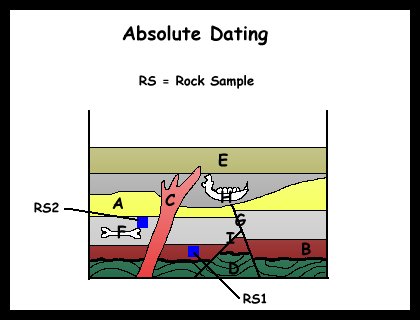
BACKGROUND: You are interested in determining the age of a dinosaur leg bone that you have recently found in Colorado in a rock layer representing river deposits. Below the dinosaur you were able to collect a piece of volcanic ash "RS1" from a layer in the mountain gravels.
Using a mass spectrometer you find that only 12.5% of the original radioactive parent element is left in RS1. The rest has decayed and changed into the stable daughter element.
Just above the dinosaur remains you collect another datable rock sample, RS2, from a thin basalt flow. You determine that 25% of the original radioactive parent element in RS2 is left.
Address the following questions in your lab summary sheet.
1. Based on the amount of remaining parent material in the rocks, how many half-lives have occurred for each?
RS1:
RS2:
2.Based on your determination of how many half-lives have occurred and with the knowledge that each half-life represents 50 million years (the half-life for the parent element you used), how old are RS1 and RS2?
RS1:
RS2:
3. What is the possible age range of the dinosaur?
4. What is your best estimate of the dinosaur's age. (Explain your rationale).
5. What geological time interval is this?