LAB 8: Mammals
Part I. Analyzing the Evolution of Tooth Diversity in Mammals
In this exercise, we will examine the teeth of reptiles and mammals. Our goal is to analyze these teeth as they represent a trend of increasing complexity towards the modern mammal dental shapes and arrangements.
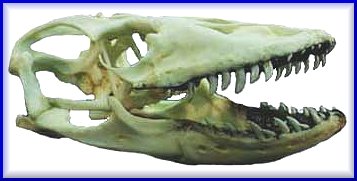
Strategy: Examine the teeth of the reptile and mammals given. You should consider: size of teeth, # of teeth (where specimen is complete), shape of teeth, etc. Answer the questions for the examples, respectively.
Example 1 Reptile
1. Examine the lower jaws of the Komodo Dragon. Are there any significant shape differences between teeth?
2. How do the upper teeth compare to the lowers?
3. What would you say about occlusion of the teeth for this animal?
Example 2 Mesozoic Mammal I (Upper Jaw...Catopsbaatar) PHOTO
1. What is the basic structure of the teeth?
2. How do they compare with the reptile teeth
3. Suggest a hypothesis as to how a series of reptile teeth could transform into this type of upper tooth:
Example 3 Mesozoic Mammal II (Lower Jaw...Zalambdelestes) PHOTO
1. What is the basic structure of the teeth?
2. How do they compare with the reptile teeth
3. Suggest a hypothesis as to how a series of reptile teeth could transform into this type of lower tooth:
Example 4 Tooth diversity of Modern Mammals
Review and summarize the diversification of the teeth of Modern Mammals .
Part II. Comparing the Skulls of Advanced Mammal-like Reptiles with Modern Mammals
Contrast the skull of Thrinaxodon (240 million years ago) with that of the modern dog. Recall from your readings the characteristics of mammal skulls. Summarize your impression of the similarities of the two (be specific).
Thrinaxodon (Download the 3-D picture from the visualization lab..this may take a few minutes)
Modern Dog Cranial Anatomy (Several views available)
PART III. Mammal Biogeography
Biogeography is the study of the distribution of animals and plants. Fossils provide us with important biogeographic clues as to how plants and animals have dispersed themselves over geologic time and how earth's changing geography and climate has played an important role. The movement of continental plates and climate played a significant role in the evolution and distribution of mammals. In this part of the lab you will examine the historical biogeography of several mammal groups.
Goal: Your goal is to evaluate how earth's changing geography, over millions of years, has been key in: 1) the general distribution and dispersal of mammal groups (e.g. the marsupials), 2) controlling the evolution of ecologically parallel faunas on different continents (i.e., the "island" ungulate faunas in North and South America) and 3) the origin and distribution of primate groups (e.g., the dispersal of humans from Africa and the dispersal of Homo sapiens from Russia through Beringia to North America 12,000 years ago).
Strategy: Using the following background reading , address the following questions.
1. How did continental positions impact the evolution, dispersal and distribution of the marsupials?
2. How did geographic isolation control and promote the evolution of ecologically parallel faunas on different continents (i.e., the "island" ungulate faunas in North and South America)
3. How have geography and climate played a role in the evolution and distribution of humans over the last 2.0 million years?