
MODULE 10: Functional Morphology and Adaptation
Objectives: In this module you will learn about the principles of Functional Morphology and Adaptation. Accordingly, we will examine how paleontologists use these principles to evaluate the lifestyles and environments of past organisms. We will also examine how the fossil record provides us with evidence of how groups of organisms adapted to take advantage of new niches in the environment or as a response to changing environments.
Background: Why do organisms have the features they do? Consider the helmet-headed dinosaurs of the pachycephalosaurus group.....
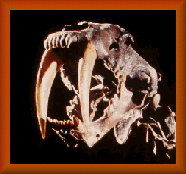
What were the functions of these peculiar morphologies? Unfortunately these animals are extinct so we can not directly evaluate how these features were used. The analysis of anatomical features to determine their significance is called functional morphology.
From the previous module on evolution you learned about the concept of natural selection that holds that individuals or groups of organisms (e.g., species) better adapted to their environments will have a higher likelihood of survival and reproduction. It follows from this principle that the features we observe on organisms are products of natural selection. For some reason, the pachycephalosaur group either benefited environmentally (e.g., protection against predation) or valued intrinsically this bone-headedness feature (e.g., competition between individuals). Likewise, the saber cat family found large canines useful for survival and/or for social utility within their species.
What do you think was purpose of these features? How would you test a hypothesis about their use?
Let's take a look at how one analyzes the anatomy of organisms to evaluate their function or characteristics. Review the following examples:
PATTERNS OF ADAPTATION IN THE FOSSIL RECORD
Paleontology provides us with an important view of how species and lineages of organisms have adapted to their environments over millions of years. The fossil record also shows us where organisms went extinct having failed to adapt to their environment.
Mammal Examples: Mammals are a excellent group to examine long-term adaptation in fossil record. After the extinction of the non-avian dinosaurs at the end of the Cretaceous (66 million years ago) they evolved to fill many of the niches left by the dinosaurs. Their story is one of adaptation from small shrew like ancestors into a multitude of shapes and sizes corresponding to ecological niches. Mammal niches vary in characteristics such as eating styles (herbivores, insectivores, and carnivores) and habitat preferences (marine, terrestrial, and flying).
Take a look at the living orders of mammals and see and gain an appreciation for their incredible evolution and adaptation.
Let's take a look at a specific group, the Equidae (includes modern horses), to see how adaptation to changing conditions promoted the development of different species. The fossil record of the horse lineage can be traced back over 55 million years. The group diversified dramatically during the Cenozoic. Much of the diversification involved getting larger, reducing the number of toes, and increasing the depth of the teeth (becoming high-crowned).
Why did these changes/trends occur within this group? Were there any changes going on in the environment that helps to explain the patterns of adaptation/evolution of the group? You be the sleuth...take a look!