
Course Description
Competence Overview
Assessment
Assignments
Readings
Syllabus (Hardcopy)
Paleontology is the study of fossils which are the remains and traces of past living things. The investigation of fossils is essential to our understanding of how life originated and evolved on earth. Fossils provide us with critical information regarding the character and age of the most significant biological events in earth's history, including: the earliest forms of life, the pivotal development of multi-celled plants and animals, the rise and demise of the dinosaurs, the adaptive diversification of mammals, and the origin of our own species.
This course will examine how fossils can be used to decipher ancient patterns of development and change within earth’s physical and biological systems, how biodiversity patterns for fossil groups compare to living groups, and how the anatomy of plant, invertebrate, and vertebrate fossil groups evolved in both form and function. Other topics will include: fossil preservation, determining the age of fossils, reconstructing ancient environments and ecosystems, biogeography, lifestyles of fossils, dinosaurs, mass extinctions and evolution.
Learning Experience: This course is offered via the internet and makes use of the exciting and growing graphical resources available there on paleontology topics. Students will be introduced to major paleontology principles and issues through readings, links to multimedia resources on the Web, structured discussions, virtual labs and simulations, virtual fossil specimens, a self-guided fieldtrip to a natural history museum or fossil site, and original inquiry into a current topic in paleontology. Assessment of student learning will be based on participation in course activities, lab reports, an essay exam on course readings, and development of a detailed research paper on a current issue in paleontology. The research paper will follow a scientific journal format and will employ scientific reasoning.
COMPETENCIES OFFERED: S-4; S-1-A; S-1-B; S-2-A;S-2-C; S-3-E (and Pre-99: PW-2; PW-4; PW-5; PW-G; PW-I; PW-O)
Competencies |
||
Current Curriculum |
Previous Curriculum |
Your Learning Outcomes |
| S4: Can describe and explain connections among diverse aspects of nature. | PW-G: Can describe and explain connections among diverse aspects of nature. |
Can describe and explain the scientific and historical connections among the earth’s Biosphere, Hydrosphere, Lithosphere, and Atmosphere as indicated by evidence in the fossil and geologic record. |
|
S-1-A: Can explore
natural phenomena or the world of everyday experiences using scientific
methods, and can use theories to interpret observations and experiences.
|
PW-2: Can employ
scientific reasoning to describe and explain natural phenomena.
|
Can develop, test, and
refine questions and/or hypotheses concerning current paleobiological
issues and controversies.
|
|
Can critically evaluate
the methodology employed and conclusions drawn by others through the
critical analysis of scholarly scientific articles.
|
||
|
Can articulate a working
knowledge of the sequence of major biological events in earth's history
as well as the scientific methods of inquiry and data employed to develop
this sequence.
|
||
|
S-1-B: Can use public
or private institutions as resources for learning science.
|
PW-I: Can use public
or private institutions as resources for learning science.
|
Can investigate, interact
with, and/or employ scientific resources from Natural History Museums
into the learning process.
|
|
S-2-A: Can describe,
differentiate, and explain form, function and variation within biological
systems.
|
Can evaluate examples of
how a fossil's anatomical form is related to its life functions and
habitat.
|
|
|
Can evaluate how variations
in anatomical form through a fossil lineage may correspond to that lineage's
changing life styles or adaptations.
|
||
|
PW-4: Understands
at least one human biological system and can explain related health
care principles.
|
Can evaluate the evolution
of the vertebrate skeletal, muscular or neurological system as indicated
by the fossil record. Can relate this development to current medical
or veterinary concerns and practices.
|
|
|
S-2-C: Can describe,
categorize, and explain development or change within physical or biological
systems.
|
Can discuss how long-term
changes in the earth's physical environment have influenced patterns
of biodiversity.
|
|
|
Can evaluate the relative
stability of life on earth as indicated by examples in the geologic
and fossil record.
|
||
|
Can assess the impact of
plant or animal population growth (and/or evolution) on earth's
ancient ecology
|
||
|
PW-5: Can describe
human growth and aging in terms of biological change.
|
Can evaluate how fossil
anatomy reflects on biological and/or evolutionary changes in their
pattern of growth an aging.
|
|
|
S-3-E: Can describe
how scientific and technical knowledge affects perspectives on the relationships
between humans and nature.
|
PW-O: Can describe
how scientific and technical knowledge affects perspectives on the relationships
between humans and nature.
|
Can critically evaluate
how fossils and the theory of evolution have impacted perspectives (e.g.,
scientific, religious, political, economic, cultural, philosophical)
on the relationships between humans and nature.
|
What you need:
1. The home address of the class is: http://www.depaul.edu/~kdowning/vp/coursepage/vp.htm Please do not distribute this URL. It is for your personal use during this quarter.
2. You need to become a member, through my invitation, to the Yahoo Club "Virtual Paleontology". To do this I need your exact e-mail address. Once I have invited you by e-mail, and you follow the ensuing Yahoo instructions, you will be able to use the Club site.
The Virtual Paleontology Club is where our discussions will take place and where the detailed class schedule resides. The site has a message board, photo section, chat room, news area, Links section, contacts section, and calendar. You need to be comfortable with using the features of the club.
3. DOWNLOADS: I) The course is optimized for and you need to download a recent version of Microsoft's "Internet Explorer". II) To access the chat room, you may also need to download new chat software as indicated by the yahoo clubs site when you get there (e.g., voice chat). III. You will likely need to download the flash and shockwave plug-ins from the macromedia site if you have not so previously. IV. Recent versions of Internet explorer should have a 3D plug-in built in..If for some reason you do not get it go to the blaxxun site and download one into the browser. Do all of this as needed!
About the Virtual Paleontology Course site:
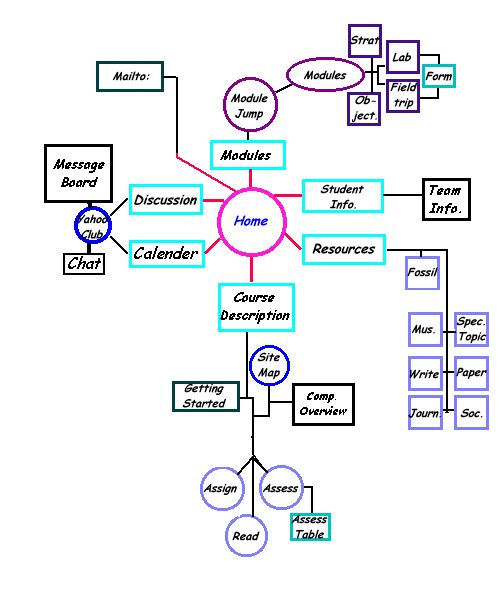
The best way to get a feel for the Virtual Paleontology site is to explore it. For a general site map press here.
As you explore Virtual Paleontology, pay careful attention to the schedule and weekly assignments. I have included a self-assessment table to help you keep track of your progress
Groundrules:
Be courteous to your fellow classmates when posting on the message board and during chat sessions. Give others a chance to express their ideas and learning. I encourage classmates to schedule additional chat sessions or post running dialogues on the message board in the context of learning. In science there is healthy degree of continuous and heated debate. Just keep any dissention from getting personal.
Some assumptions:
This course requires proficiency with internet browsers as a starting point to learning. It is assumed that you are already proficient with browsers (e.g., know what a URL is) and word processing programs (i.e., Microsoft word) and can download such things as documents and plug-ins (where needed).
The expectation is that this course will be a paperless class and that you will send your classwork to me through e-mail. (The sole exception will be to hand deliver and pick-up assignments at the O’Hare Campus where it has been pre-arranged with the instructor.)
Academic Policy:
I follow the DePaul University code for student academic integrity that can be found at the online student handbook. Essentially, do your own work!
About the Technology:Technical Questions/Problems about your computer should be directed to DePaul's ATD department and not the instructor. See the link on the Depaul homepage for technological help.
Inform the instructor of broken links or exciting new ones that you have located.
BROWSER INFO:
The Virtual Paleontology materials are built and optimized for Internet Explorer (4.0+ versions). It is strongly recommended that you use Internet explorer since the latest course version was tested with this program. If you find the graphics are not lining up properly or other script problems occur, you may need to download (for free) the latest version of these programs. NOTE: In a pinch…. these browsers are available to students on the DePaul Computer Lab terminals.
Also note that the course was optimized for 1024 X 678 pixel and 800 X 600 pixel monitors. Please adjust your monitor's resolution accordingly. You may also wish to limit (i.e., close) the number of tool bars your browser has open to see more of the graphics.
Speeding Up The Graphics:
If you have a pre-pentium PC computer or corresponding "old MAC", graphics will take longer (or substantially) longer to load. You can speed up things somewhat by not deleting the cache file that will store the course graphics.
While DePaul’s server is usually very reliable, it may go down from time to time. Hang in there it will come back. If it happens during a chat session we will reschedule.
Assessment |
Self-Assessment Table |
||
About this course:This course is offered via the internet and makes use of the exciting and growing graphical resources available there on paleontology topics. Students will be introduced to major paleontology principles and issues through readings, links to multimedia resources on the Web, structured chat-room discussions, virtual labs and simulations, fossil specimen kits, a fieldtrip to a natural history museum or fossil site, and original inquiry into a current topic in paleontology. Assessment of student learning will be based on participation in course activities, lab reports, an essay exam on course readings, and development of a detailed research paper on a current issue in paleontology. The research paper will follow a scientific journal format and will employ scientific reasoning. |
|||
1) Demonstration that student understands concepts and has broad knowledge of topical information included in course, by successful completion of a quiz and final examination (take-home).2) Completion of an original inquiry term paper focusing on a problematic issue in paleobiology and written in a science journal format.3) Completion of virtual lab exercises and fieldtrips.4) Preparation for and participation in chat and message board discussions, debates, and fieldtrip. |
|||
Assessment Activity Weighting:1. At-home quiz. (5%)2. At-home Final examination for respective competencies (30%)3. Participation and Leadership in chat and message board discussions. Students should respond to questions in both discussion formats on a regular and thoughtfully prepared basis. (20%)4. Virtual Field Trip and Lab exercises (15%)*You are required to do all lab exercises, however you will turn in summaries for 3 labs of your choice.*Likewise, you are required to do a fieldtrip option for every module, however you will turn in summaries for 3 fieldtrips of your choice5. Original Research Paper (30% total)Preliminary Steps (outline, references, firstdraft)(5%)Final Draft....... (25%)6. Additional points may be earned by completing the assignments of other optional fieldtrips or other supplementary assignments when designated by the instructor as "extra credit". |
|||
Grade Distribution:My grading philosophy is that one can learn a great deal from feedback from others. Therefore, students are typically given the opportunity to redo exam/quiz work to improve their scores if they have made a thoughtful first attempt. Students are also encouraged to turn in research paper drafts early to permit feedback and improvement.The expected grade breakdown for this class is:A = 92-100A- = 90-91B+ = 87-89B = 82-86B- = 80-81C+ = 77-79C = 72-76 |
|||

HOME