Gordon Ramsey (
| We then did
the
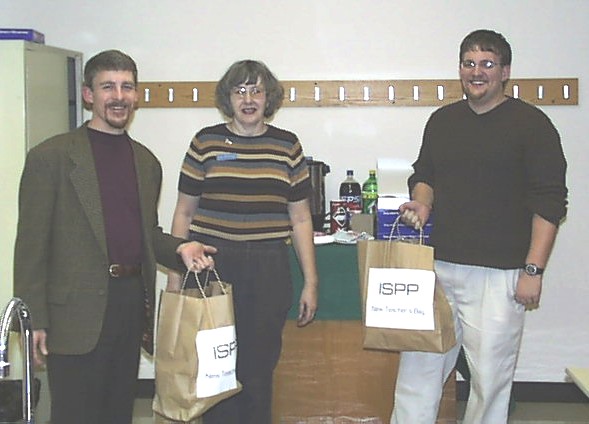
announcements listed at the top of this Reminder. In addition, two of the teachers from the Gordon Ramsey ( |
|
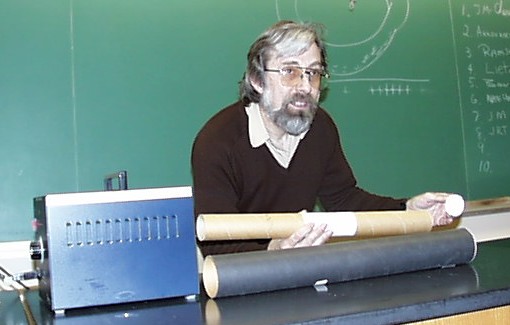
| Gordon brought an air
blower with him to blow into the tube and excite resonance. He showed us how it worked and we listened to
the resonance with the tube closed. He
asked the question again and we answered. In
general everyone agreed that the open tube will have a
higher
pitch. Some said the frequency will
double. Others weren’t sure about that. The open and closed tube equations were put on the overhead along with some wave diagrams. There was the usual discussion of pressure and displacement nodes. When solved for frequency the equations predicted the frequency should double. Gordon then sounded the closed and open tubes and passed out sheets with tube and frequency data. In the small tube the pitch went up almost an octave (D3 and C#4) and the large tube fell significantly short (C3 to B4). We generally agreed the shortage was due to end effects. This was a very nicely done phenomenological presentation. Thanks Gordon. |
 |
| Martha Lietz
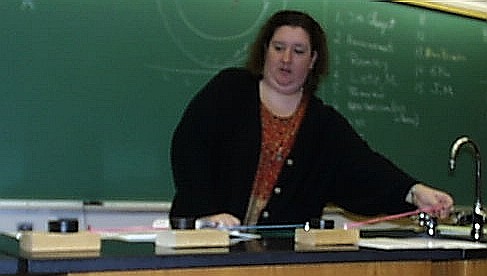
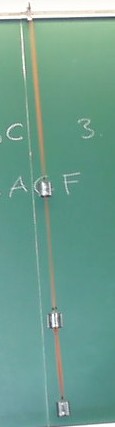
( We gave our votes and were pretty sure we were correct (we were), but Martha said her students had to think hard and draw in the forces carefully. Then she pulled the blocks along the table to show us we were correct. Mike Matkovich said he connected his blocks with spring scales. |
 |
|
Ken Bowen (
| Nate Unterman
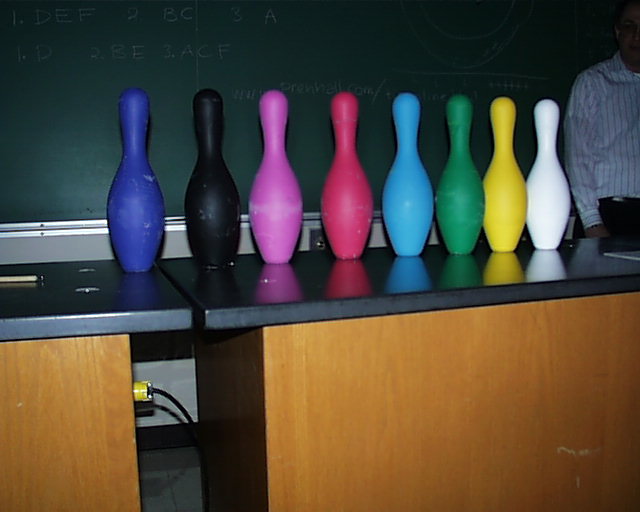
( Nate passed out a sheet with two pages. The second page is a nice student worksheet. The first sheet describes how Nate got the bowling pins and matched the paint colors with the slide colors. Thus must be carefully done because not all gels are identical. Nate described a nice procedure for matching gels and paints and had a few tips on painting pins. Someone suggested dichroic filters for theatre lights give a pure spectrum color but they go for $40 each. |
 |
 |
 |