OUR NEXT MEETING…
...is at The University of Chicago
Wednesday
March 19, 2003
6:30 - 9:00 p.m.
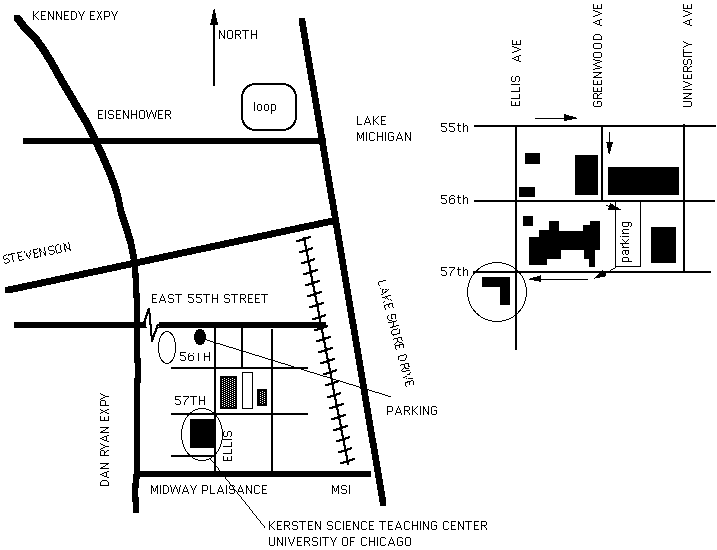
Click here for a map and directions.
FUTURE MEETINGS…
April 10 (Thu) Lake Forest College
May 12 (Mon) Northwestern University
June 3 (Tue) Columbia College Chicago
OTHER MEETINGS…
CSAAPT Saturday March 29 – Northeastern Illinois University
(Paul Dolan/Joe Hermanek)
ISAAPT Fri – Sat April 11-12 – Knox
College, Galesburg
ANNOUNCEMENTS…
Roy Coleman (Morgan Park High School) brought the results of
the Chicago-area bridge contest. Click here to see
them.
Nate Uterman (Glenbrook North High School) announced an Amusement Park Physics Workshop ($70) at Argonne Labs, March 24. Seventeen of 24 positions are already filled. email cprzyzycki@dep.anl.gov to register.
Nate also mentioned Physics Days will be May 6 and 7. $28.75 per student. Hours from 9 to 5.
Click here to get information about a Master's degree program in teaching physics to be offered through Roosevelt University. This information comes from Bruce Illingworth of Physics Northwest.
Editorial Comment: I think it’s useful to remind ourselves of the point of the ISPP and our getting together. Although it does feel good to see all the old friends, our business is teaching. The use of phenomena to embody the physics we are teaching, and the strategies we use to allow the students to extract the laws of Physics from phenomena are what we should be about. That’s not to say that we can’t use the meetings for other purposes; to pass out a joke, to tell a good story, etc., but we do need to be careful that everyone, especially new visitors, realizes what we are about at every meeting.
AT OUR LAST MEETING…
We were welcomed to Northeastern Illinois University by Paul Dolan
and the rest of the faculty of NEIU. Paul brought out a couple homemade
“thunder tubes” that you read about in previous Reminders. It’s a
large tube (from a good sized mailing tube to the 2m x 15cm diameter tube
Paul had). Attach a stretched out spring to one capped end and listen
to the tube resonate as the spring is shaken. Paul got a couple suggestions
for improving his, but I thought it made a very nice low tone.
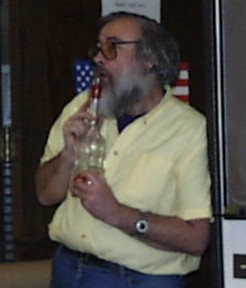
| Paul then brought out various empty liquor and wine bottles. He asked if the shape of the bottle influenced the pitch. Paul blew into several different bottles and they definitely had different pitches. They also had different shapes and volumes. Gerry Lietz (DePaul University) suggested that Paul get a couple flasks of equal volume and different shapes. Paul produced an erlenmeyer flask and a florence flask. They are roughly conical and spherical with stems. Both were 100 or 200 ml. The erlenmeyer flask had a definitely higher pitch. No one had a good explanation for this. We have something to think about for next month.Paul then brought out a torsion pendulum he found in the back room. A discussion of various ways to use it followed. Someone said you can still see it in the Sargent-Welch catalog. | |
John Milton (DePaul University) mentioned a website for the time it takes to hear thunder when you are various distances from lightning. It’s http://whyfiles.org/137lightning/index.html (scroll down for the applet). The sound travels about one fifth mile per second so the thunder can be some time behind the lightning.
John then passed out an article he copied from the Chicago Tribune business section (February 15) describing a chip that generates an electric field. When an object such as a person enters the electric field, changes in the field are detected by the chip. The chip then controls the air bag in a car or some other device.
Finally, John passed out a portrait of a woman looking in a mirror. He questioned whether a person standing where the artist could actually see the woman as she is seen in the painting. He challenged his students to try to pose each other as the woman is posed. When they have difficulty they remember that light reflects at equal angles.
Tom Senior (New Trier High School) brought a “pass out” describing the exact lengths to cut straws to make the pan pipes he described at an earlier meeting. There is a chart listing the frequency of each pipe.
Then Tom took out a small flashlight, a microlight wand, he got at the Evanston Arts supply store. Their website is www.cksauce.com. It is $12.95 and consisted of a red, green, and blue LED. The lights can be projected as overlapping circles and we could clearly see the cyan, magenta, and yellow produced. Tom made a cup out of aluminum foil. He directed the microlight wand into the cup and held a paper napkin over the opening. The light mixed pretty well in the cup. This light was programmable. You can also get LED-95 from All Electronics; www.allelectronics.com for $3.75. This is a single LED that flashes 3 colors, one after the other. Not programmable but interesting. They also have a super bright red LED for $0.75 that was pretty amazing.
Jim Clark (Northern Illinois University) led a discussion of
the second law of thermodynamics and Maxwell’s demon. He tried to
relate it to the uncertainty principle.
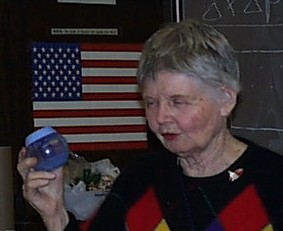 |
Eileen Wild (CPS, retired) brought a bottle designed to pour a specific dosage. You could squeeze it to fill a container on the side and then pour it out. Tipping the bottle breaks the connection between the bottle and the side container. She also brought a fabric softener ball that shows inertia in action. A person fills the ball with softener and pulls the heavy plug into place from inside the ball. When the washing machine enters an energetic cycle the ball is butted around and the plug comes loose releasing the softener. We threw it around the room to see how well it worked. |
Bob Stehman (Northeastern Illinois University) mentioned a multidiscipline
project funded by NASA in cooperation with DePaul University. They
are trying to develop space science modules with activities. We discussed
the energy generated by a meteor and the temperature change that could
be expected.
| Nate Unterman (Glenbrook North High School) brought a news release and the track layout of a new ride at Great America called Superman – Ultimate Flight. You hang horizontally on it. He also brought the new Pasco accelerometer. It is still in the experimental stage, but they are loaning out a few. It’s all contained in a device about the size of a large cell phone and is downloadable to a computer. It’s also a barometer. Look at www.Newton.DEP.ANL.Gov/app/Info.htm for more information on Physics Day. | 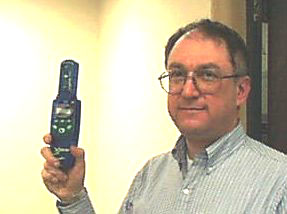 |
Debbie Lojkutz (Joliet West High School) brought a 38 oz Ajax dishwashing liquid bottle that says it has 50% more mas (sic) than the regular size. This led to a nice discussion with her class of the differences between mass, weight, and volume.
Debbie also mentioned a demonstration she does. She gathers a small number of aluminum cubes and an equal number of copper cubes with the same volume. She shows the students that the copper is significantly heavier. She pours the aluminum cubes into a graduated cylinder with water and marks the amount the water rises. She then asks the class to estimate the height the water will rise when she puts the copper cubes into an identical cylinder. Debbie says that more than half her class thinks the water will rise more than it did with the aluminum because the copper is heavier. This is a nice distinction between weight and volume.
Ann Brandon (Joliet West High School) brought a circuit analysis worksheet and described what she did in class to prepare the students. She says that once the students have done the problems with a breadboard and multimeter, then they have no problems with the worksheets. Ann says you can get free 9V batteries from your Theatre department as they only use them for one show. Tom Senior says the fire department gives out free batteries when they are promoting smoke detectors.
Joel Baum (NEIU grad student) gave us a brief review of a book on quantum gravity.
Paul Dolan (Northeastern Illinois University) our host, ended
the meeting with a few observations. He said Ann and Debbie’s balloon
crusher worked very well with eggs. It was remarkable how much weight
the egg held and it held more vertically than horizontally. He also
burned a couple nuts and mentioned an experiment done at the college by
Syed Igbal to determine the calories of a nut by burning. Paul also
passed out a form we could use to submit papers for the CSAAPT meeting
at Northeastern Illinois University March 29. Phone 773-442-5785
or email P-Dolan@neiu.edu if you wish to contact Paul.
| Paul had several “give-aways” to end the meeting. There were lots of journals of some obscure subject, and chad punchers for computer cards. Then he had some cups that change color when a cold liquid is poured in. I can’t wait to see my grandson’s face when I pour him some cold fruit punch and the cup turns the color of the punch. They are available from Educational Innovations, website www.teachersource.com. If you haven’t seen their stuff, take a look. You’ll be impressed. | 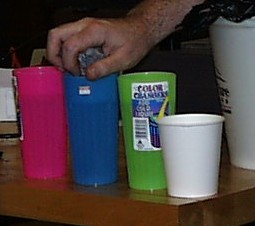 |
See you next time at the University of Chicago.
Submitted by Pete Insley
BRING FRIENDS! BRING IDEAS!! SEE YOU AT NEIU!!!
THE CHICAGO REGIONAL BRIDGE RUILDING CONTESTS...
...were held on Tuesday, Feb. 11, 2003, and complete results may be
found at www.iit.edu/~hsbridge. Here are the winners:
|
|
|
|
|
|
|
|
||||
| First | Duran, Oscar | Morgan Park | 36.00 | 2452.3 |
| Second | Kaminecki, Matt | St. Ignatius | 67.00 | 2310.5 |
| Third | Harris, Robin | Resurrection | 31.00 | 2094.6 |
| Fourth | Johnson, DeCarlo | Harlan | 58.00 | 2073.0 |
|
|
||||
| First | Ruffatto, Don | Lincoln-Way Central | 58.00 | 3259.5 |
| Second | LaFave, John | Waubonsie Valley | 66.00 | 2145.0 |
| Third | Herrera, Oscar | Bloom Trail | 45.00 | 2075.6 |
| Fourth | Blaser, Michael | Joliet Central | 53.00 | 2067.8 |
|
|
||||
| First | Shaw, Mike | Wheaton-Warrenville South | 57.00 | 3199.2 |
| Second | Behrens, Kelli | Wheaton-Warrenville South | 42.00 | 2820.7 |
| Third | Norris, Sam | Evanston Township | 33.00 | 2403.5 |
| Fourth | Patrick, Brittany | Prairie Ridge | 43.00 | 2158.6 |
First and Second place winners received bridge kits and information to compete in the International Contest to be held at IIT, Chicago on April 26. For prizes, First place winners had first choice of a Digital Camera, a Rio mp3 Player, or a Palm PDA. Second place winners had second choice, and Third place had third choice. All, including Fourth place winners, also received Bridge Contest T-shirts. All the above winners received invitations to the Engineering Week Dinner, thanks to Chief Judge George Krupa.
Each of the schools having winners received an elegant trophy for display. All participating schools will receive - via US mail (or via ISPP meetings) - photos of their students who participated, and all students will receive a Certificate of Merit, with special Certificates for winners. All students have already received an impressive medallion with red-white-blue ribbon. These are worn around the neck to identify them as participants within their schools and physics classes. Each has also received a special coffee mug, courtesy of the Illinois Engineers Council. The Frank Garcher "traveling" Supertrophy was awarded to St. Ignatius High School (Chicago) thanks to Matt Kaminecki, whose bridge carried the greatest load, 67 kg. A total of 131 bridges were tested by students from 44 city and suburban high schools at this 29th Annual Contest.
A BIG THANK YOU!!...to the Committee (Bill Blunk, Ann Brandon, Roy Coleman, Tom Jensen, George Krupa, Eduardo de Santiago, Carol Segre, Bill Shanks, Lee Slick, Jim Stankevitz, Thomas Torres, Earl Zwicker) who have made it happen by giving of their talent and time. Several have served for 29 years!
There is a parking ramp on the southeast corner of 55th St. and Ellis Ave. -- entrance is on Ellis. Park there (for free after 5 pm) and walk two blocks south to Kersten Physics Teaching Center, on the southwest corner of 57th and Ellis.
Greetings! I met with Roosevelt officials
Thursday, March 6 and ironed
out most of the final details of a MATL program. This is an unofficial,
very informal announcement but I believe it is accurate and I present
the
details in no particular order. I would be glad to TRY to answer
any
questions this may generate. The program really looks fantastic
and will
be unique in the country. Roosevelt is very anxious to begin
this program
and they are VERY accommodating regarding your interest in a relevant
physics program. Official literature will be forthcoming.
1) Time: beginning 6/03 and ending approx. 8/05 (summer-fall spring
x2)
2) Cost: $15K for 36 hours, 6 hours at a time ($2500 x 6).
If you have >
3.5 UNDERGRAD you will receive a scholarship > 30%! Good behavior
pays
off...
3) This summer: 6/16 to 6/27 - 2, 3 hr education courses, M thru F,
9-4
4) Fall: 2 physics courses, Mechanics, 4 hrs (T-Th 4:30-6:30 at Barrington
HS taught by none other than Jim Hicks) and Using Demonstrations, 2
hrs (4
Saturdays TBA , 9-3 taught by a dream team TBA - no joke).
5) At the conclusion of this program you will have a MATL degree with
18
QUALITY hrs of physics and 18 hours of ed courses that relate to the
teaching of PHYSICS. Wait there's more! At the conclusion
of the program
(approx. 8/05) you will be eligible to apply for National Board
Certification. If approved (approval comes about 11/05 and we
hope at
least 80% of you will become certified), you will receive $3,000 annually
for 10 years from the state and you will also be eligible to be a paid
mentor... This is the icing on the cake.
6) Contact Dr. Susan Belgrad, Roosevelt Univ./Robin Campus, 1400 N.
Roosevelt Blvd, Schaumburg 60173, 847-619-8834
7) That's it for now! I hope this appeals to you.
Bruce Illingworth
billingw@dist214.k12.il.us