Easy!
For a binary search tree with N keys and height, h, maximum
height occurs if every node has a null link so that the tree is
essentially a linked list:
h = N - 1
The worst case number of comparisons for a search is
height + 1.
So the worst case for an ordinary binary search tree is
h + 1 = N
So the cost for the get method is O(N) in the worst case
for a binary search tree.
A 2-3 tree is always perfectly balanced: For every Node, the
height of its left subtree is the same as the height of the right
subtree.
This guarantees that for a 2-3 tree with N nodes, and height h:
N = 2(h + 1) - 1
So
h = log2(N + 1) - 1 <= log2(N)
Note that N is the number of nodes, not necessarily the number
of keys since each node can contain either 1 or 2 keys.
A 2-3 tree with no 3-nodes is a perfectly balanced binary
search tree. So as just noted, for its height, h
h <= log2(N)
where N is
the number of Nodes. But if there are no 3-nodes, each node
contains only 1 key.
So for such a perfectly balanced binary search tree
h = O(log(N))
where h is the height and N is the number of keys
AVL trees are Binary Search Trees with the additional property that
the methods maintain a "balanced" property:
      For every node in an AVL tree, the heights of its children differ by
      at most 1.
For the purpose of this definition (and also the implementation), an
empty child will be considered to be at height -1.
The AVL tree below shows the height of each node.
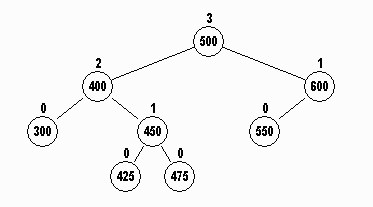
      The children of 600 have heights

       0 (left child 550) and
      -1 (right child empty).

      and these differ by only 1.
For a perfectly balanced binary search tree with N keys we saw
h = O(log(N))
But what about the height of an AVL tree with N
keys?
What is an upper bound for the height of an AVL tree with N
keys?
This can be determined if we can answer the reverse
question:
What is a lower bound for the number of keys in an AVL tree of height
h?
Let N be the minimum number of keys that can be in an AVL tree of
height h.
Fact
2h / 2 < N
But this means
h < 2log(N)
Great! The height of an AVL tree is O(log(N)).
Since the height = O(log(N), this means the get method
is guaranteed to be O(log(N)) for an
AVL tree, even though it isn't perfectly balanced.
The put method first does a
search and then either updates a value or else changes a few links
to attach a new key value pair. Since the height is O(log(N)),
this much would also cost only O(log(N)) for the put method.
However, the put method must also maintain the balance
property. So we have make sure that doesn't add any more than
O(log(N)) additional steps.
Maintaining the AVL Tree property, requires that the insert
includes some code to rebalance portions of the tree if the property
would otherwise be violated.
For example if we try to insert the value 525 into this tree in
the usual way as a child of 550, the height of 550 would
become 1, while the right child (empty) of 600 is still at height -1,
a difference of 2.
So the node with 600 would become unbalanced!
This problem is solved by:
      1. First insert in the usual way for a binary search tree either in
      the left subtree or right subtree. (Duplicates are not allowed in
      this version.)
      2. Check if the heights of the two children subtrees differs by 2.
      If so, then rotate nodes to restore the AVL properties.
Two rotation methods are needed: rotateLeft or rotateRight.
To rebalance an unbalanced node requires we will need to either do one
rotation or two rotations, depending on how the node became unbalanced.
The rotate methods are:
      1. private Node rotateLeft( Node p )

      2. private Node rotateRight( Node p )
Returning to the example AVL tree, we try to insert 525:
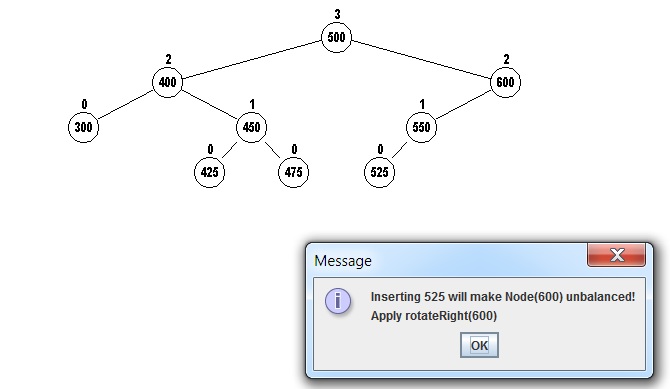
The rotateRight method below is called to rotate the node
p to the right with its
left child, 550 becoming the parent of 525 and 600:
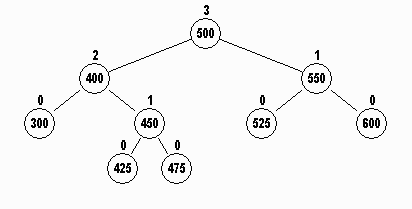
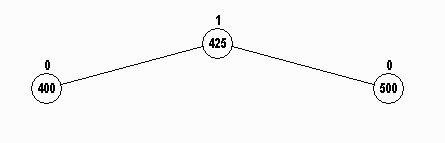
If we try to insert 425 into this tree, node 500 would
then violate the AVL condition. However, we can't use the
rotateRight method:
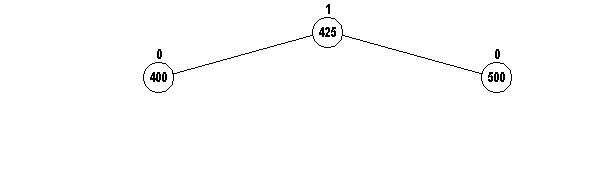
First rotate 400 to the left with its new
right child (425), and then rotate 500 with its new left
child (425 again in a new position) to the right to get:
A slightly more typical example of two rotations is shown
below. The value 450 is being inserted:
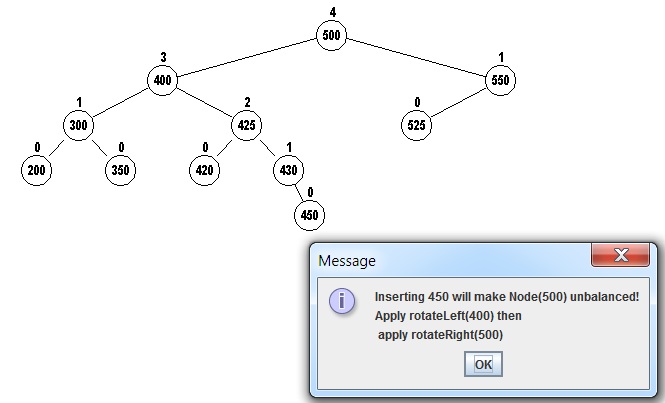
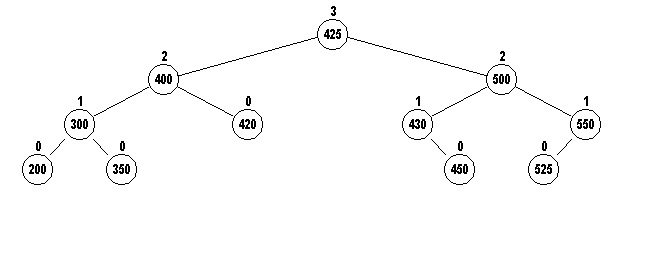
The rotateLeft will rotate 400 to the left, making
425 the new root of the subtree, then rotateRight will
rotate 500 to the right making 425 the new root of the tree.
What happened to 425's previous left and right children?
Here is the method:
private static Node rotateLeft( Node p )
{
Node r = ?;
p.right = ?;
r.left = ?;
return r;
}
Note: The height method is a static method that just returns the height of
the node passed to it, but also handles the case if null is
passed. In the later case, height returns -1.
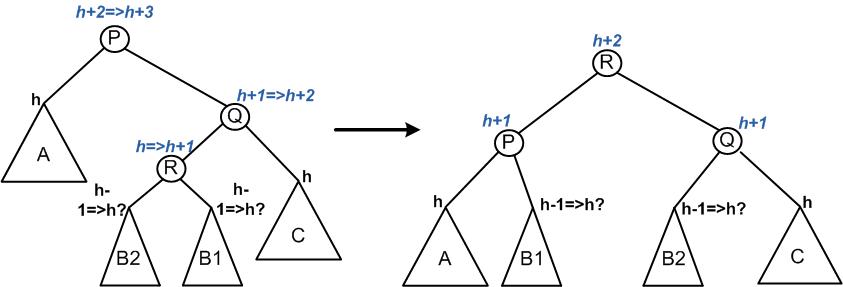
Two rotations are required:
 rotateRight Q
 rotateLeft P

 /*
      * item inserted to right of t and left of t.right.
      * node t is unbalanced and requires two rotations
      *
      * 1. rotate t.right to the right and attach the new subtree root to t.right
      * 2. rotate t to the left and return the new subtree root
      */
Assume a private Node class is used for an AVL tree
class:
public class AVL<E extends Comparable<E>>
{
  // AVL members and methods
  ...

     // inner class
     private static Node
     {
       public E data;
       public Node left;
       public Node right;
       public int height; // optional

       public  Node() {}
       public Node(E x) {
	 data = x;
	 height = 0; // optional
       }
     }
}
Recall insertion (without rebalancing) into a Binary Search
Tree. We assume the BST has a private member root whose
value is null if the BST is empty:
private Node root;
public void put(Key k, Value v)
{
   root = put(k, root);
}

private Node insert(Key k, Value v, Node t)
{
  if ( t == null ) {
     t = new Node(k,v);
  } else if ( k.compareTo(t.key) < 0 ) {
     t.left = put(k, v, t.left);
  } else if ( k.compareTo(t.key) > 0 ) {
     t.right = put(k, v, t.right);
  }
  return t;
}
An AVL tree is a binary search tree with a balance condtition
The insertion for an AVL tree uses the same code as for any
biinary search tree (above), but must add code to keep the AVL
tree balanced and to compute changes in heights of nodes:
public void insert(E x)
{
   root = insert(x, root);
}

private Node insert(E x, Node t)
{
  if ( t == null ) {
     t = new Node(x);
  } else if ( x.compareTo(t.data) < 0 ) {
     t.left = insert(x, t.left);
     // If t is unbalanced call rotate method(s) to restore the balance
  } else if ( x.compareTo(t.data) > 0 ) {
     t.right = insert(x, t.right);
     // If t is unbalanced call rotate method(s) to restore the balance
  }
  // Recompute the height of t if height is member of Node
  return t;
}
Which rotation should be used when a node bcomes unbalanced depends on
which child subtree (left or right) the offending value was inserted
and which subtree (left or right) of that
child.
Single rotation: rotateLeft(p) (changes 2 links)
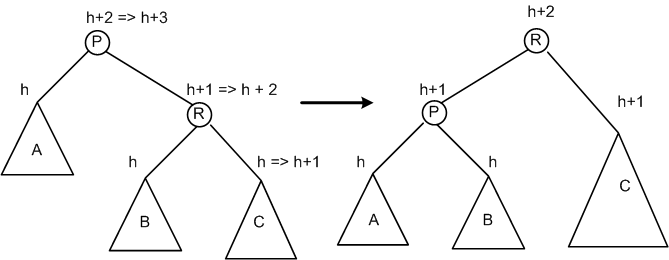
Double rotation: rotateRight(p.right), then rotateLeft(p)
(changes 4 total links)
Here is a sketch of the proof that an AVL tree with N keys has
height h = O(log(N)).
Let f(h) be the minimum number of keys in an AVL tree of height
h.
(For example, try to draw AVL trees of heights 1, 2, and 3 with
the smallest number of keys.)
      f(-1) = 0
      f(0) = 1
      f(1) = 2
For h >= 1,
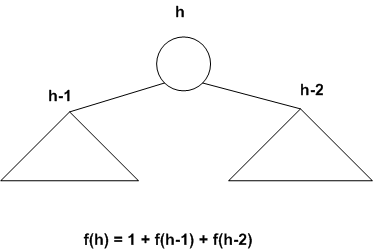
Since f(h-1) >= f(h-2), we get
| f(7) > 2f(5) |
f(8) > 2f(6) |
| f(7) > 22f(3) |
f(8) > 22f(4) |
| f(7) > 23f(1) |
f(8) > 23f(2) |
| f(7) > 232 |
f(8) > 24f(0) |
| f(7) > 24 |
f(8) > 24 |
In general,
where ceiling(x) means the smallest integer that is >= x.
To print all the keys in a binary search tree in order, we
should visit the nodes:
- left subtree, then
- the root, then
- right subtree
This is called inorder
traversal.
For example, the keys() method of the binary search tree symbol table uses a
private recursive method that visits the Nodes in preorder, adding
them to a Queue or LinkedList.
Question: If the keys of a binary tree are output in inorder: 1
2 3 4 5 6 7, is the tree balanced (i.e., an avl tree)?
Uh, oh. The inorder output tells us nothing about the shape of
the tree.
Preorder
Preorder just visits the root first:
- the root, then
- left subtree, then
- right subtree
Postorder
Postorder just visits the root last:
- left subtree, then
- right subtree, then
- the root
(Draw some examples)
If the preorder listing is given, can you determine the
original tree?
Example
Preorder: 40 50 80 60 90
Draw the tree?
The level number (or depth) of a node in a binary search
tree is the distance from the root.
Level order means to list the
keys in order by their level and for keys on the same level, list
them from left to right (that is, in increasing order).
Listing
ALL the keys in a binary search tree in their usual order doesn't
give any information about the shape of the tree. Is it balanced,
essentially a linked list, or what?
However, if the keys are listed in level order you can use this
as the INPUT order to rebuild the original tree! So instead of
drawing binary search trees they can be described by giving the
level order list of keys.
Level order of a binary search tree: 80 30 90 10 85 5 20
89 12.
What is the level order after inserting 70?
Level order of a binary search tree: 80 30 90 10 85 5 20
89 12.
What is the level order after Hibbard deletion of 5, 10 and 80?
(Hibbard deletion of a Node with 2 children replaces that Node
with its successor.
Level order of a binary search tree: 80 30 90 10 85 5 20
89 12.
If we search for key 15, what keys in the tree are compared for
this search miss?
What about a search for key 100?
Level order of a binary search tree: 80 30 90 10 85 5 20
89 12.
What is the level of key 20?
What is the height of the subtree at 20?
Level order of a binary search tree: 80 50 100 30 70 90 105 20
40 60 85 10
Is this an AVL tree?
Level order of an AVL tree: 80 50 100 30 70 90 105 20
40 60 85 10
The key 65 is inserted into this tree. Is a rotation required?