Binary Search Trees have worst case performance for the symbol
table operations - put and get - the same as for a linked
list.
To guarantee these operations have order of growth log(N), we
need to keep the trees balanced.
Keeping the tree balanced guarantees that the paths have length
proportional to log(N).
Both put and get must traverse one path and so traversing a
path will cost at most log(N) operations.
But we have to add to this the cost of rebalancing.
So the cost of keeping the tree balanced must be small so that
the order of growth of put and get remains log(N).
One definition of balanced is too restrictive:
For every node, the height of the left and right subtrees of the
node should be equal.
How many nodes are in such a tree if the height if h?
Answer:
2h + 1 - 1
Proof:
Correct for h = 0.
If T(h) is such a tree of height h > 0, then its left and right
subtrees are of height h - 1.
So the number of nodes in each subtree must be:
2h - 1
The total number of nodes in T(h) is then
      2 * (2h - 1) + 1 = 2h + 1 - 2 + 1 =
      2h + 1 - 1
So only "balanced trees" with this definition could only exist
provided the number of nodes is of this this special form!
So we need a slightly less restrictive definition.
So what should it mean for a BST to be balanced?
There are several possibilities that all lead to all paths in
the tree having length at most proportional to log(N).
Two different kinds of balanced BSTs using slightly different
definitions of balanced are:
AVL trees are Binary Search Trees with the additional property that
the methods maintain a "balanced" property:
      For every node in an AVL tree, the heights of its children differ by
      at most 1.
For the purpose of this definition (and also the implementation), an
empty child will be considered to be at height -1.
The AVL tree below shows the height of each node.
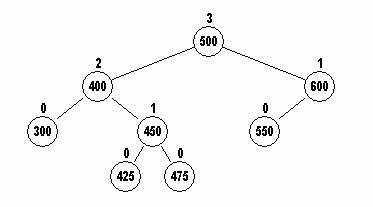
      The children of 600 have heights

       0 (left child 550) and
      -1 (right child empty).

      and these differ by only 1.
What is the an upper bound for the height of an AVL tree with N nodes?
This can be determined if we can answer the reverse
question:
What is a lower bound for the number of nodes in an AVL tree of height
h?
Let f(h) be the minimum number of nodes that can be in an AVL tree of
height h.
Then
      f(-1) = 0
      f(0) = 1
      f(1) = 2
For h >= 1,
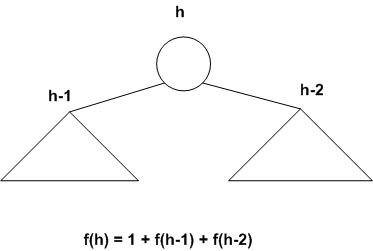
Since f(h-1) >= f(h-2), we get
| f(7) > 2f(5) |
f(8) > 2f(6) |
| f(7) > 22f(3) |
f(8) > 22f(4) |
| f(7) > 23f(1) |
f(8) > 23f(2) |
| f(7) > 232 |
f(8) > 24f(0) |
| f(7) > 24 |
f(8) > 24 |
In general,
where ceiling(x) means the smallest integer that is >= x.
Let h be the maximum height for an AVL tree with N nodes. Then
f(h) must be <= N.
2h/2 < f(h) <= N
Taking log2 we get
      h/2 < log2(N)

      or

      h < 2log2(N)
So the height of an AVL tree with N nodes is O(log(N)).
Maintaining the AVL Tree property, requires that the insert
includes some code to rebalance portions of the tree if the property
would otherwise be violated.
For example if we try to insert the value 525 into this tree in
the usual way as a child of 550, the height of 550 would
become 1, while the right child (empty) of 600 is still at height -1,
a difference of 2.
So the node with 600 would become unbalanced!
This problem is solved by:
      1. First insert in the usual way for a binary search tree either in
      the left subtree or right subtree. (Duplicates are not allowed in
      this version.)
      2. Check if the heights of the two children subtrees differs by 2.
      If so, then rotate nodes to restore the AVL properties.
Returning to the example AVL tree, we try to insert 190:
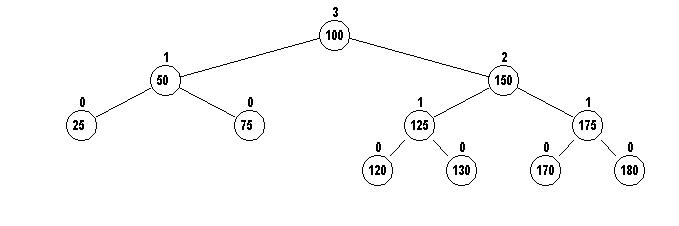
The rotateLeft(Node t) method is called where t is the
unbalanced Node (100 in this example) to rotate the t and its
right child to the left.
The result is
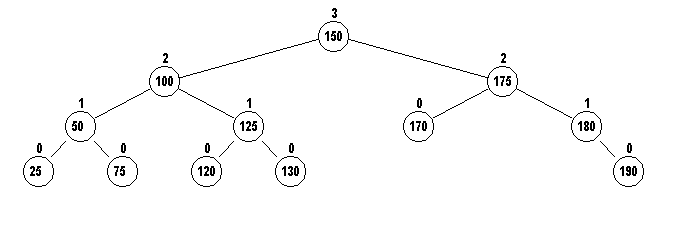
What happened? How many links were changed?
What is the code for void rotateLeft(Node t)?
                 100 [h=3]
                /   \
               /     \
      [h=1]   A      150 [h=2]
                    /   \
                   /     \
            [h=1] B       C [h=1]
Inserting 190 will make subtree C at 175 have height 2 with
children of height 0 and 1
(175 will
still be balanced).
This makes the subtree at 150 height 3 with children of height
1 and 2
(150 will still be balanced)
But this makes the subtree at 100 unbalanced. Its children will
have heights 1 and 3
(100 will be unbalanced)!
           100 [h=3]                                           150 [h=3]
          /   \                                               /   \
         /     \                                             /     \
  [h=1] A      150 [h=2 -> 3]            =>           [h=2] 100     C [h=2]
              /   \                                        /   \
             /     \                                      /     \
      [h=1] B       C [h=1 -> 2]                   [h=1] A       B [h=1]
Here is the method:
private Node rotateLeft( Node t )
{
Node r = ?;
t.right = ?;
r.left = ?;
t.height = max( height(p.left), height(p.right) ) + 1;
r.height = max( height(r.left), height(r.right) ) + 1;
return r;
}
Note: The height method just returns the height of
the node passed to it, but also handles the case if null is
passed. In the later case, height returns -1.
  Node * insert(const Key& k, const Value& v, Node *rt) {
    if (rt == NULL) {
      rt = new Node(k,v);
    } else if (k < rt->key) {
      rt->left = insert(k, v, rt->left);
    } else if (k > rt->key) {
      rt->right = insert(k, v, rt->right);
    }
    return rt;
  }
 Node * insert(const Key& k, const Value& v, Node *rt) {
    if (rt == NULL) {
      rt = new Node(k,v);
    } else if (k < rt->key) {
      rt->left = insert(k, v, rt->left);
      if ((height(rt->left) - height(rt->right)) > 1) {
        // balance ??

        if (k < rt->left->key) {
          rt = rotateRight(rt);
        } else {
          rt ->left = rotateLeft(rt->left);
          rt = rotateRight(rt);
        }


      }
    } else if (k > rt->key) {
      rt->right = insert(k, v, rt->right);
      if ((height(rt->right) - height(rt->left)) > 1) {
        // balance ??

        if( k > rt->->key) {
          rt = rotateLeft(rt);
        } else {
          rt->right = rotateRight(rt->right);
          rt = rotateLeft(rt);
        }

      }
    }
    rt->ht = max(height(rt->left), height(rt->right)) + 1;
    return rt;
  }
 Node * insert(const Key& k, const Value& v, Node *rt) {
    if (rt == NULL) {
      rt = new Node(k,v);
    } else if (k < rt->key) {
      rt->left = insert(k, v, rt->left);
      if ((height(rt->left) - height(rt->right)) > 1) {
        // balance

        if (k < rt->left->key) {
          rt = rotateRight(rt);
        } else {
          rt ->left = rotateLeft(rt->left);
          rt = rotateRight(rt);
        }


      }
    } else if (k > rt->key) {
      rt->right = insert(k, v, rt->right);
      if ((height(rt->right) - height(rt->left)) > 1) {
        // balance

        if( k > rt->right->key) {
          rt = rotateLeft(rt);
        } else {
          rt->right = rotateRight(rt->right);
          rt = rotateLeft(rt);
        }

      }
    }
    rt->ht = max(height(rt->left), height(rt->right)) + 1;
    return rt;
  }
Do the keys in a symbol table need to be comparable for...
- SequentialSearchST (linked list)
- BinarySearchST (sorted vector)
- BST (binary search tree - not rebalanced)
- avlBST (binary search tree with rebalancing)
Read dow jones stock closing data from a file (1895 to 2005) then be able
to provide the closing average for any input date.
- What if the date is before 1895 or after 2005?
- What if the date is in the range 1895 to 2005, but was a
weekend date or a holiday?
- Require keys to be comparable
- Do not require keys to be comparable
We want additional methods for these symbol tables:
      Key min();
      Key max();
      void deleteMin();
      void deleteMax();
      Key floor(const Key& key);
      Key ceiling(const Key& key);
What is the specification of the ceiling function?
How would it help to handle the dow jones stock problem?
How would we implement ceiling for
- SequentialSearchST
- BinarySearchST
- BST
- avlBST