Textual Analysis





Introduction (Self Diagnosis)

I started the quarter by writing a
self-diagnosis of my own English
skills: those I had crafted and those
I apparently lacked. I highlighted my inability to properly incorporate a comma and detailed experiences with doubtful high school English teachers.
I discussed my ability to analyze literature and the appreciation I have
for vocabulary and word selection.
After printing the self-diagnosis I found
it to be somewhat negative, but I was focused on following through on my pledge to “quit my addiction to commas”. With this information, and more that
will be provided through out my portfolio, I present to you this quarters work, and my own thoughts on the products I have created.
The first assignment was a textual analysis. Dubbed as the most difficult assignment and thus chronologically assigned as our first to “get it out of the way”. For some reason I found this assignment to be painless. Although I made some mistakes I felt that the drafting of this paper was simple and more black and white than the other coursework. The process started by honing my skills at drafting a rhetorical précis. The rhetorical précis was a useful tool and helped me create an outline for my first draft.
I completed 3 drafts for the textual analysis. The first draft edited solely by my peers. Two of my classmates sorted through my analysis to find kinks and errors that I overlooked before clicking “Print…”
A fellow student in the class, Neel Sinha, pointed out to me that my textual analysis needed to “sound more like an analysis than elaborating on what the author is saying”. Neel’s advice didn’t register with me at the moment but in hindsight I realized that ignoring this piece of editorial feedback cost me a lot of time when it came to finishing my final draft. I worked on the little details that were marked as incorrect and it wasn’t until Mr. Moore marked my second draft with plenty of “all summary” remarks (reinforcing Neel’s advice) and queries as to where my mention of ethos, pathos, logos and tone were.
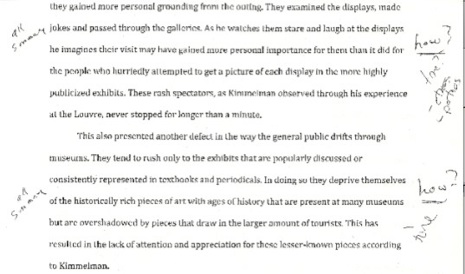
Mr. Moore told me in class that I had completely lacked any remarks on ethos, pathos and logos. I used this to my advantage and for my next and final draft. I inserted in appropriate areas how Michael Kimmelman, the writer whose work I was analyzing, used various aspects of ethos and pathos but disregarded logos as a tool. For my final draft I wrote about what I thought at the time was a “sympathetic tone…to gain approval of readers who may not find a camera the best way to capture the significance of a work of art”. However, after hearing various discussions in class when the assignment was finished I found myself agreeing with classmates and Mr. Moore who said his tone was condescending.
I turned in my final draft that I believed to be fine-tuned. I had the various elements of a rhetorical analysis pinned down: purpose, audience and context. While the purpose and context were spread throughout the analysis I waited until my final paragraphs to point out the audience. As defined by the Compose, Define, Advocate guidebook the audience, or reader, is “an abstraction, a ghost-like presence hover around the production of the writing” (Lynch, Wysocki 189). In most writings, just like the article I analyzed, the audience is never clearly defined but rather implied, which made for the most difficult part of my textual analysis final draft. In my final draft, shown below, I identified Kimmelman’s audience as “the readers of the New York Times” and described various characteristics and examples of those readers.


After finishing the paper I was satisfied. Three drafts made for a difficult and long process, I just wanted a grade and to put it in the pass. This would not be the case for the rhetorical analysis though. Mr. Moore wrote us individual letters regarding our papers pros and cons, students were to use these letters to argue the grade they thought they deserved. My letter consisted of praise such as “admirable control over the features of a textual analysis” however critiqued my choice to “raise and drop ethos/pathos briskly”. Went arguing for my grade with Mr. Moore I brought up his comments and described the choices I had made in the final draft that led to those outcomes. I argued for an A given that although my mention of ethos and pathos was brief it was there, which was also my reasoning for not asking for an A+.

