Matt: The Ride
Film professor and director Matt Irvine talks about DePaul’s
growing film program, his favorite films and being famous in Japan
By David Brown
Editor in Chief
 |
|
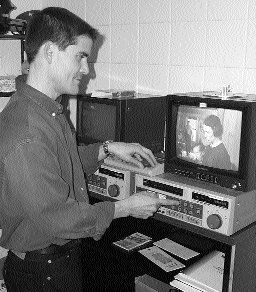
Cinema buff and DePaul professor Matt Irvine works his editing magic on Orson Welles’ classic, “Citizen Kane.” Irvine is currently at work on his latest feature film. DePaulia photo by Jim Distasio |
What’s your favorite movie?
That’s a question Matt Irvine asks of every student in his video production classes to begin every term. He says it helps him remember names, but it’s also a one-question psychological test.
If a student responds, “Oh I dunno … I just saw ‘American Pie.’ I liked that a lot,” it’s likely that person doesn’t have an unrivaled passion for cinema. But it’s also possible he or she was put on the spot.
“When they say something really silly, it’s tough,” Irvine said. “For example, I like ‘Cabin Boy.’ I own it and have watched it 20 times. I sat through it twice in theaters. So I understand when someone says ‘Waterboy.’ It’s all taste.”
For Irvine’s video and documentary students, who learn to produce short films utilizing digital cameras and computer editing programs, the question of favorite film also offers a peek into what kind of movie they’ll likely make in class.
“I can always tell a moviephile from the answers,” Irvine said. “And I can tell if they’re not really that serious about movies. That’s OK, but for the next 10 weeks we assume you will be.”
One of Irvine’s colleagues, film professor Deborah Tudor, said Irvine’s work in the field of film allows him to not merely teach out of a text.
“Matt’s very professional. He’s worked in the industry as director and writer and is familiar with all aspects of production,” Tudor said. “He provides a real context in which the students learn.
“And he’s extremely witty.”
Irvine is serious about film, but his sense of humor and unique teaching style make him one of the more easygoing personalities in the university.
He’s one part teacher, one part filmmaker and one part amusement park attraction. Whether he’s teaching screenwriting, documentary production or video production, being in one of his classes is a unique experience.
“He’s more like ‘Matt the Ride’ than ‘Matt the Professor,’ “ said lab assistant Megan Marco. “But he’s a strict grader. Sometimes people mistake his outgoing personality and friendliness with being an easy grader. He’s very serious about grades.”
Irvine’s personal tastes, which range from anything directed by Martin Scorsese to a good slasher pic, have shaped his lesson plans, as well as his own filmmaking. He recently completed his first full-length motion picture, an untitled film about a boy who believes his dead brother has come back to life through a wooden doll he finds in the forest. OK.
Irvine acknowledges there’s a darker side to the films he enjoys to watch, and that dark side spills over into his teaching and filmmaking.
“I don’t know where it comes from,” Irvine said. “And if I did, I think it would stop me from creating. I don’t know why, and maybe that’s why I keep pursuing and keep making stuff and trying to create films.”
Whatever is buried deep inside Irvine’s psyche, he expresses himself as a quirky, energetic and outgoing instructor. And he would like to emphasize the latter.
“I told my wife, if I never make another film, and I could continue to teach, I’d be extremely happy,” Irvine said. “Some people find it a little strange that I am a happy filmmaker, that it’s impossible. But I’m not happy because I’ve made movies, I’m happy because I love to teach.”
His wife confirms Irvine’s inexhaustible glee.
“He wakes up singing, reciting poems, full of energy,” Wendy Irvine said. “He’s an incredibly quirky, creative person.”
Irvine has experienced a little bit of Hollywood, and is content to keep at least one foot out of the film industry.
“There are no ethics in the movie industry-and that’s fine,” Irvine said. “A lot of people hide behind friendship or a smile or a pat on the back and then try to rob you blind.”
Irvine wrote and was supposed to direct the sequel to 1960s cult horror classic “The Carnival of Souls,” but producers took control of the project, ejecting him from the production.
“It turned into garbage,” Irvine said. “You create a film and it becomes like your child. Then you have to give it away. That whole experience really soured me on the Hollywood way of things.”
But Irvine got over it and doesn’t let the experience quash his joy for movies.
“I am so proud of how he’s handled this current project,” Wendy said. “He’s letting his producer handle the business end of things.”
Irvine said he leaves all the nonsense to his producer, Gregg Elder of the Outside Media Group. Elder, who was one of Irvine’s students at Columbia College in Chicago, is handling the selling of Irvine’s film.
“All people want to know is who is starring, who is attached to the project,” Elder said. “The film itself, most distributors don’t care. In America we’re very star-obsessed.”
“They don’t even read the script half the time,” Irvine added.
It’s not that way in Japan.
That’s where Irvine’s 1994 thesis film “Stillwater” was a big hit, winning jury prize for best entry in the Tokyo Film Festival.
Irvine isn’t sure why he’s such a hit in the Land of the Rising Sun.
“I’m like Spinal Tap over there, though,” he joked.
Elder thinks Irvine’s storytelling abilities are similar to Japanese Anime, which also include lots of gore and just enough sex.
“But it’s still really weird,” Elder added. “That’s the only thing I can think of.”
Irvine also has written a play, based on his experience growing up one of four boys in northern Indiana.
“One of these days, I’ll put on the play,” Irvine said.
Class gets new stuff
Students who enroll in Video or Documentary Production with Irvine will have an advantage no previous class has had. Gone are the monstrous analog editing decks which, while charming, resembled your parents’ first VCR from 1978. Also gone are the heavy and awkward analog cameras, which produced dubious sound and inconsistent picture quality.
Thanks to $20,000 in improvements, the video lab is completely digital and up to date with the rest of the academic filmmaking world-for now. Eight new cameras, five new Apple I-Mac computers with easy-to-use editing programs and new sound equipment affords any student the opportunity to become the next Martin Scorsese. (OK, the next Peter Hyams.)
“Making films is very expensive,” Irvine said. “It’s not like painting, where you can work in a medium and spend $50 on a canvas, paint and brush. Digital video cameras have changed that.”
Director Francis Ford Coppola, in the 1990 documentary “Hearts of Darkness,” could see that feature films weren’t always going to be the exclusive domain of bloated movie studios.
“All this will change when some little girl in Ohio in the backyard of her house takes her daddy’s video camera and makes a beautiful motion picture with a video camera,” Coppola said in the film that chronicled the making of his 1979 Vietnam odyssey, “Apocalypse Now.”
According to Marco, the commitment DePaul has made to the new cameras and computers is appreciated, but cautioned that technology is always changing.
“We don’t want to fall behind on this. I don’t think, in my opinion, DePaul has recognized how big this is,” Marco said. “People need to understand that every business is going to need people who know how to make video presentations.”
She is also stumped as to why a wider variety of students haven’t taken Irvine’s video classes.
“Business and computer science majors, art majors-I’m surprised we don’t get more of them,” Marco said. “We do get a lot of ‘filmies,’ too-people who just love every aspect of movies.”
While the classes at DePaul are designed for students to produce short films, if someone wanted to make a full-length feature film they could do it with the new equipment.
“Spike Lee just did a movie (“Bamboozled,” which opens Oct. 6) with the same stuff we have in this lab,” said Marco, a junior media art/art history major.
“Computers do scare some people. Editing has goes from, ‘Here’s your camera and your two VCRs,’ to computer editing. If they come from a background in which they didn’t use a computer, jumping right into digital editing is a big deal.”
But the I-Movie program, while user-friendly, has several sound effects and visual options. It allows filmmakers to add graphics, titles and transitions to films. Finished products, which tend to last about five minutes, can have the look of a professional film if enough care is taken.
“Compared to what they do at Columbia, which is a full film school, the films made at DePaul are quite good,” Irvine said. “You can have all the fancy equipment in the world, but it gets back to the individual filmmaker.”