|
1
|
|
|
2
|
|
|
3
|
- Self-governing recovery homes
- Rental housing
- 6-10 recovering people in a house
- No residency time limits
- Rules
- Pay equal share of rent and expenses
- Zero tolerance -- Expulsion for alcohol or drug use
- Follow house rules decided by majority house vote
|
|
4
|
- Grassroots movement
- Founded in 1975 by Paul Molloy
- now over 1,200 Oxford Houses within 40 states
- about 10,000 individuals
- The network of Oxford Houses is
- Self-administered and operated
|
|
5
|
- A substance-free environment without restrictions on length of stay
- opportunity to live away from relapse triggers
- might help residents remain substance-free
- Encouragement to spend time with one another
- might develop interpersonal networks that support abstinence
|
|
6
|
- Residents held accountable for their behavior by peers in recovery
- residents must pay rent
- contribute to the maintenance of the home
- refrain from engaging in disruptive behaviors
- If residents are disruptive
- fined
- required meet with other residents to address their difficulties
- If problems persist
- residents placed on a “contract”
- specify needed behavior changes
|
|
7
|
- Expectations for appropriate behavior plus consequences such as fines
and contracts
- might provide contingencies that help individuals in recovery develop
interpersonal and other life skills
- Oxford House residents encouraged utilize 12-step groups
- might contribute to long-term sobriety among individuals in recovery
|
|
8
|
- Data collected in 11 states
- Consistent with studies from substance abuse programs
- 53% never married
- 58% Caucasian
- 78% male
- 71% at least high school education
- 69% employed
- 64% had experienced homelessness
- Jason, Ferrrari, Groessl & Dvorchak (1997)
|
|
9
|
- 11 Oxford Houses (OH) were opened in Illinois beginning in 1992
- Interviews conducted with 132 residents who had recently entered the
houses
|
|
10
|
- Reasons for choosing to reside in an OH
- Fellowship and a structured setting where successful substance abuse
outcomes were enforced
- Residents said this setting:
- allowed fellowship with similar others
- stability in their life
- a period of time for personal growth and change
- Jason, Ferrari et al. (1997)
|
|
11
|
- Women more likely:
- reported sexual abuse
- diagnosed with eating disorders
- engaged in writing bad checks prior to recovery
- sought OH for a structured and safe setting
- Men more likely:
- engaged in drug sales and theft
- entered OHs as an attempt to rebuild relationships
- Ferrari, Curtin-Davis, Dvorchak, & Jason (1997)
|
|
12
|
- 82% residents had previous history of criminal involvement
- 76% used 12-step programs
- Most able to maintain employment
- Jason, Ferrari, Smith et al. (1997); Nealon -Woods, Ferrari, &
Jason (1995)
|
|
13
|
- 62% positive outcomes
- remained in the house or left on good terms
- Those with lower pessimism scores stayed longer than those with higher
pessimism
- Older residents longer stays than younger residents
- Length of stay positively related to increases in Perceived Sense of Community
- Bishop, Jason, Ferrari, & Huang
(1998); Bishop, Chertok, & Jason (1997)
|
|
14
|
- Psychiatric Diagnoses
- 58% Antisocial Personality Disorder
- 39% Mood disorders
- 35% Post Traumatic Stress Disorder
- 52% reported two or more psychiatric disorders
- 21% had no psychiatric disorder
other than substance abuse
- 6 month Follow-up: 69% had positive outcomes
- remained residents or left the house on good terms
- Majer, Jason, Ferrari &
North (2002)
|
|
15
|
- NIAAA study randomized outcome study
- within the state of Illinois
- comparing outcomes of Oxford Houses and usual post-treatment residence
- NIDA study
- longitudinal design
- national sample of Oxford House residents
|
|
16
|
- Participants just completing substance abuse treatment
- Randomly assigned to either an Oxford House or Usual Care condition
- 150 of 154 approached individuals agreed to participate
- All participants assigned to Oxford House condition were accepted
|
|
17
|
- Participants were interviewed every 6 months for a 24 month period (Four
waves)
- Across the 24-month assessment
- Oxford House, 89%
- Usual care, 86%
|
|
18
|
- Examined repeated measures data over time nested within individual
(i.e., person-level characteristics such as demographic and
condition-related variables)
- Dependent variables included
- substance abuse related outcomes
- employment status outcomes
- criminal activity outcomes
|
|
19
|
- OH compared to Usual care group
- higher abstinence rates (69% vs
35%)
- An important person in each participant’s support network confirmed
the participant’s level of abstinence at the 24 month follow-up
- higher monthly income ($989 vs
$440)
- lower incarceration rates (3% vs
9%)
- Jason, Olson, Ferrari, & LoSasso (2006)
|
|
20
|
- Oxford House condition
- 14 women were able to obtain custody of their children
- 1 woman lost custody
- Usual care condition
- 6 women gained custody of their children
- 2 women lost custody of their children.
|
|
21
|
- at 24 Month Follow-up
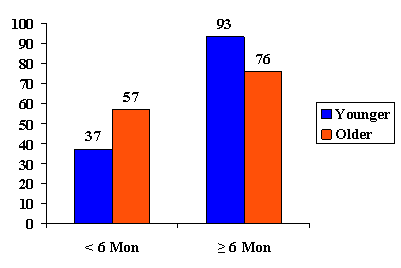
- OH residents with ≥ 6 months compared to < 6 months living in an OH
- Higher abstinence (84% vs 54%)
- Higher employment rates (85% vs 68%)
- Higher self-regulation scores
- Jason, Olson, Ferrari, Majer, Alvarez, & Stout (2006)
|
|
22
|
|
|
23
|
|
|
24
|
|
|
25
|
- Examined the processes of social support,
self-efficacy, and abstinence
- Explored in a national sample of Oxford House residents (n = 897)
- Residents were recruited and interviewed at an initial baseline phase
- then re-interviewed at three subsequent
- 4-month intervals (waves)
|
|
26
|
- Contacted a random sample of the
participant's most important people
- vast majority of collateral reports consistent with participants’ self
reports of abstinence
|
|
27
|
- 13.5% had relapsed
- Employment
- income significantly increased from $794 to $942 per month
- 80% of participants employed
- Incarceration
- less than 5%
- Jason, Davis, Ferrari, & Anderson (in press)
|
|
28
|
- Staying in OH at least 6 months was related to increased self-efficacy
and maintaining abstinence
- Results are consistent with partial mediational process
|
|
29
|
|
|
30
|
|
|
31
|
|
|
32
|
- Oxford Houses across diverse
regions of US
- residents were found to live in rather similar dwellings
- Houses were generally located in mid to high SES
- few intoxicated persons, drug dealers, or homeless
- few empty lots, pawnshops, or bars/pubs nearby
- public transportation was available
- streets and neighborhoods were clean
- well lit at night
- Ferrari, Jason, Sasser, Davis, & Olson (2006)
|
|
33
|
- US vs Australia OHs
- Neighborhoods of Oxford Houses similar
- community amenities
- grocery stores
- churches
- medical clinics
- Ferrari, Jason, Blake,
Davis, & Olson (2006)
|
|
34
|
- Observed interactions during business meetings at 29 Illinois Oxford
Houses
- Policies and organizational issues
- Action plans included strategies to correct a resident’s problem
behavior
- Developing an action plan was related to receiving emotional support
- Voting was associated with lower conflict and increased communications
involving action plans
- Jason, Ferrari, Freeland,
Danielewicz, & Olson (2006)
|
|
35
|
- Both prohibited:
- self-injurious behaviors
- setting destructive acts
- destroying site property or possessions of others
- OHs more liberal
- sleeping late in the morning or staying out late at night
- going away for a weekend
- having “private time” in their locked room with guests
- have their own personal possessions (pictures, furniture)
- Ferrari, Jason, Davis, Olson, & Alvarez (2004)
|
|
36
|
- OH residents compared to clients from traditional inpatient criminal
justice programs
- No significant differences:
- education
- job history
- criminal history
- drug use
- Oleniczak, Olabode-Dada, Viola, Davis,
Olson, Ferrari, & Jason
(2002)
|
|
37
|
- History of serving time in jail
- 83% of OH members
- 55% for the 12-step members
- 12-step members with convictions
- lower optimism and less confident that they could remain abstinent
- Oxford House members with and without convictions
- similar levels of optimism and beliefs they could remain abstinent
- Majer, Jason, & Olson
(2004)
|
|
38
|
- 6 months or longer living in an OH
- associated with lower levels
- criminal and aggressive behaviors
- Aase, Jason, Olson, Majer, Ferrari, Davis, & Virtue (2006)
|
|
39
|
- 90% used alcohol and cocaine for over 10 years
- 67% had experienced depression
- 46% had attempted suicide
- 95% had experienced some form of past trauma
- Despite these severe past histories
- highest Sense of Community scores of any group ever examined with this
measure
- Olson, Curtis, Jason, Ferrari, Horin, Davis, Flynn, & Alvarez
(2003)
|
|
40
|
- Good leaders had the following qualities:
- knowledge of rules
- good role models without being overbearing or bossy
- compassionate, open-minded, and listened to others
- Women in the houses viewed children with a sense of responsibility
- regardless of whether or not the child were their own
- Children had a positive effect on house members
- D’Arlach, Olson, Jason, & Ferrari (2006); Davis, Dziekan, Horin,
Jason, Ferrari, & Olson
(2006)
|
|
41
|
- Psychiatric severity over a one-year period
- No significant differences residents with high versus low baseline
psychiatric severity
- number of days in outpatient
- residential psychiatric treatments
- abstinence rates
- Majer, Jason, North, Davis,
Olson, Ferrari, Aase, & Molloy (2006)
|
|
42
|
- 292 female and 604 male residents of OH
- those not employed
- used medical care more often
- those who used pharmaceutical drugs
- used medical care more often
- Ponitz, Olson, Jason, Davis, Ferrari (2006)
|
|
43
|
- Neighbors next to an OH and a block away
- Property values not significantly different
- Those who lived next to an OH versus had significantly more positive
attitudes:
- concerning the importance of substance abusing individuals being able
to live in residential neighborhoods
- about the importance of neighbors providing a supportive environment to
those in recovery
- regarding attitudes of a self-run recovery home on their block
- Jason, Roberts, & Olson
(2005)
|
|
44
|
- Significant correlation between the length of time staying in an OH and
involvement in the community
- 86% of residents felt that living in the Oxford House increased their
likelihood of involvement in their neighborhoods
- OH residents reported spending 10.6 hours per week on neighborhood
involvement
- 35% were involved in mentoring others in recovery
- 44% were involved in administering and running support groups.
- 56% were involved in educating the community about the OH
- 36% were involved in educating the community on recovery in general
|
|
45
|
- Involvement in community initiatives:
- 39% of participants reported involvement in informing or advising
agencies or local leaders
- 32% reported involvement in community anti-drug campaigns
- 16% speaking at political events
- 30% attending community meetings
- 21% public hearings and forums
- Jason, Schober & Olson
(2006)
|
|
46
|
- Significant expansion of houses when states employed an outreach worker
to provide technical assistance
- Jason, Braciszewski, Olson & Ferrari (2005)
|
|
47
|
|
|
48
|
|
|
49
|
- Many clients return to former high-risk environments or stressful family
situations
- Returning to these settings without a network of people to support
abstinence increases chances of relapse
|
|
50
|
- Like Oxford Houses
- Important public policy implications for stabilizing individuals with
substance abuse histories
|
|
51
|
- More information on these
studies is available at:
- http://condor.depaul.edu/~ljason/oxford
|

 Notes
Notes