I received a B. S. in Electrical Engineering from Tennessee Technological University in 1986 and a Ph. D. in Physics from the Georgia Institute of Technology in 1991. I am currently a Professor in the Physics Department at DePaul University where I teach courses ranging from a first year seminar entitled The Little Ice Age: Charting the Uncertain Future of Global Climate to specialized upper-level courses such as Laser Physics and Fiber Optics.
Winter Quarter 2006 Courses
The web pages for these courses can be found on the Blackboard system, which is available to students enrolled in the courses.
Physics 225 - Weather and Climate (Syllabus Only)
Physics 300 - Methods of Computational and Theoretical Physics I (Syllabus Only)
Current
Research
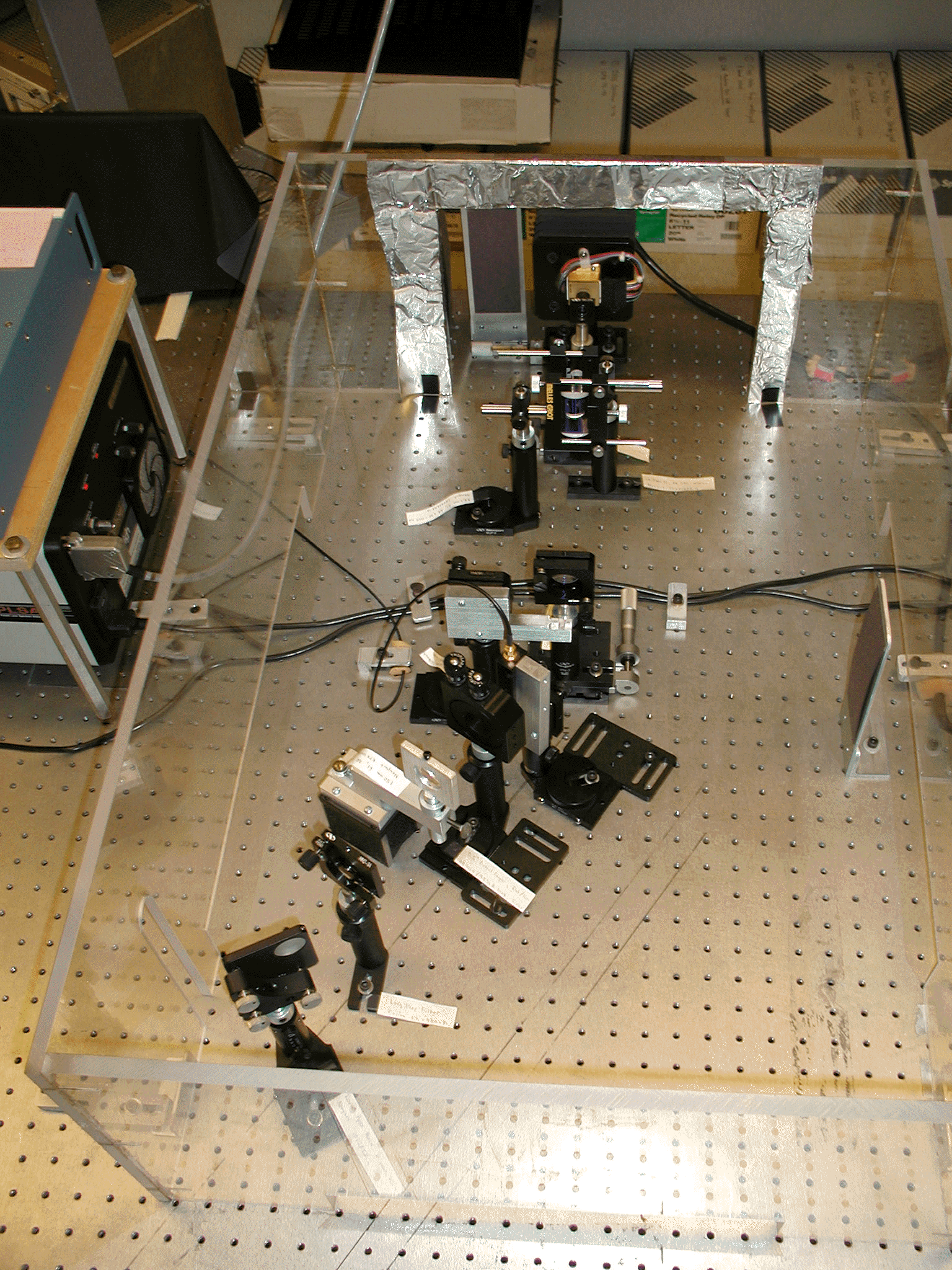
My primary area of research is nonlinear pulse propagation in optical fiber, and the goal of my research is to understand how quantum and classical noise evolves when intense light interacts with matter. These two sources of noise, one intrinsic to the nature of light and matter and the other a consequence of the coupling between the experiment and a fluctuating macroscopic environment, collectively determine the statistical properties of light when it interacts with matter. I am particularly interested in moderately complex stochastic systems in nonlinear optics where multiple sources of noise are shaped and entangled by multiple or cascaded nonlinear processes. We are currently investigating the shaping of classical and quantum noise that takes place in multi-order Raman generation in optical fiber; the picture at the bottom of this page shows part of the experimental facilities.
An in-depth understanding of how the statistics of a noisy optical signal are shaped by interaction with a nonlinear material is important in a wide range of applications, such as nonlinear frequency conversion, the production and measurement of ultrashort pulses, and optical amplifiers for fiber-optic communication systems. The blending of randomness and determinism is also an integral part of natural phenomena, such as the dynamics of the weather or a population of plants or animals. Such natural systems are often so complex as to defy detailed analysis. We hope that our work with moderately complex stochastic systems in nonlinear optics will enhance our understanding and appreciation of their highly complex counterparts in nature.
Finally, it is a pleasure to acknowledge the assistance of many talented undergraduate and Master of Science students who have helped carry along and enrich my research. A total of 27 students, 15 undergraduates and 12 masters students, have worked with me over the past 14 years. Our work has been supported by DePaul University, Research Corporation, and the National Science Foundation.
Diode-Pumped, Q-Switched, Nd:YAG Laser System